White Egret Symbolism: Spiritual Meaning, Signs, and Hidden Messages
A white egret standing quietly beside a lake is an unusual sight to forget. Its long legs, curved neck, and bright feathers give it an almost still, peaceful appearance. It may spend several minutes watching the water before suddenly moving to catch a fish. This behaviour has inspired people to connect the bird with patience, awareness, and knowing when to act. White egret symbolism is commonly associated with purity, peace, wisdom, independence, and spiritual awareness. Some people also see it as a reminder to remain calm during uncertain times and trust their own journey. Its meaning becomes even more interesting when we look at the bird’s relationship with water, its hunting habits, and its remarkable conservation history.
What Does a White Egret Symbolize?
A white egret commonly represents purity, patience, peace, clarity, independence, and quiet strength. Its white feathers are often connected with innocence and simplicity, while its slow movements suggest careful observation and self-control.
The bird’s behaviour gives these interpretations a natural starting point. An egret often stands still in shallow water, watching for fish and other small animals. It does not waste energy chasing every movement. Instead, it waits until the right moment to strike.
This can be interpreted as a reminder to think before acting and avoid rushing important decisions.
Here are some common symbolic associations:
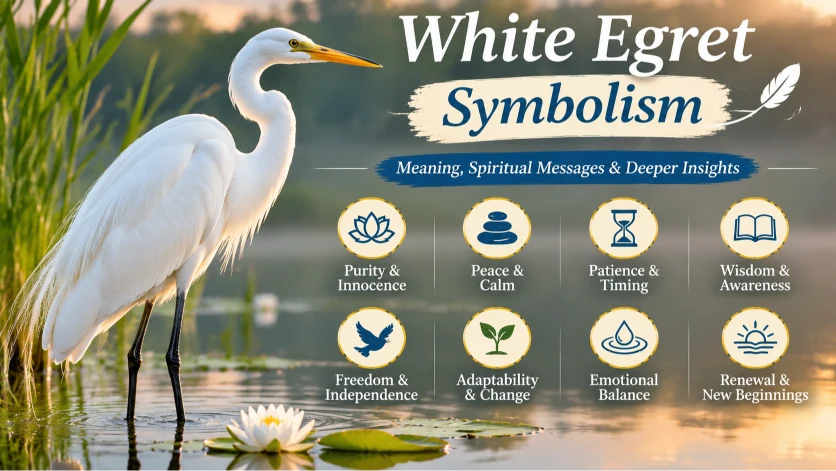
- Purity: Living with honesty and clear intentions.
- Peace: Finding calm during stressful situations.
- Patience: Waiting for the right opportunity.
- Wisdom: Observing before making decisions.
- Independence: Being comfortable with your own path.
- Adaptability: Adjusting to changing circumstances.
- Renewal: Leaving old difficulties behind and starting again.
These are symbolic interpretations, not fixed messages that every culture or person assigns to the bird.
The Meaning Behind the Egret’s Natural Behaviour
The egret’s everyday habits offer some of the most interesting ways to understand its symbolism.
Standing Still: The Value of Patience
One of the easiest ways to recognize an egret is by its hunting posture. It may stand almost motionless in shallow water, waiting for a fish to come within reach.
This behaviour is often connected with patience and self-control.
In everyday life, people sometimes feel pressure to make quick decisions. They may rush into relationships, career changes, or financial choices because they are afraid of missing an opportunity.
The egret offers a different symbolic idea: sometimes waiting and observing is the better choice.
Its stillness can remind us that taking a break does not mean giving up. It can mean preparing for the right moment.
Walking Through Water: Emotional Awareness
Water has long been used in literature and art to represent emotions, memories, and the unconscious mind.
Because egrets spend much of their time around wetlands, rivers, ponds, and coastal waters, people may connect them with emotional awareness.
An egret walking through calm water can represent the ability to move through difficult feelings without allowing them to control every decision.
This interpretation is especially meaningful for someone who is learning to handle change, grief, disappointment, or uncertainty.
Flying Away: Freedom and Independence
When an egret spreads its large white wings and flies across a wetland, it creates a very different image from the bird standing quietly in the water.
Its flight can represent freedom, independence, and the willingness to move beyond familiar surroundings.
This symbolism may connect with people who are considering a new direction in life, leaving an unhealthy situation, or exploring opportunities in a different place.
The bird’s flight suggests movement and possibility.
Searching for Food: Focus and Determination
An egret does not rely on appearance to survive. It must pay attention to its surroundings, recognize opportunities, and act quickly when prey comes within reach.
This behaviour can be connected with focus and determination.
Symbolically, the bird encourages people to pay attention to their goals and use their abilities wisely. Progress often comes from consistent effort rather than waiting for everything to happen at once.
Why Does the White Colour Matter?
The white feathers are a major part of the egret’s symbolic meaning.
Across many visual and cultural traditions, white is associated with purity, cleanliness, simplicity, peace, and new beginnings.
When these associations are connected with the egret’s graceful appearance, the bird can become a symbol of a fresh perspective or a clear mind.
However, white does not mean exactly the same thing everywhere. In some cultures, white is also associated with mourning and funeral traditions.
This difference matters because the symbolism of a white egret depends partly on the cultural background of the person interpreting it.
The bird’s white appearance can also be connected with honesty and sincerity. It may remind someone to make decisions that match their values instead of trying to impress other people.
White Egret Spiritual Meaning
In modern spiritual interpretations, the white egret is often associated with awareness, inner peace, personal growth, and trusting the direction of life.
Some people interpret seeing one as a reminder to pay attention to their thoughts and surroundings. Others connect it with a period of reflection or a need to make more thoughtful decisions.
There are several ways people understand its spiritual symbolism:
A reminder to slow down: The egret’s patient hunting style can encourage you to stop rushing and consider your next move.
A period of personal growth: Its association with water and renewal can represent emotional development and a fresh outlook.
Trusting yourself: The bird’s independent behaviour may remind you to make choices based on your own values.
Finding inner peace: Its calm appearance can encourage quiet reflection and a more balanced approach to daily life.
Accepting change: Its ability to move between different wetland environments can be interpreted as a reminder to remain flexible.
These are personal spiritual interpretations rather than messages established by science or shared by every religious tradition.
What Does It Mean When You See a White Egret?
The circumstances of a sighting can influence the meaning someone gives to it. Here are some common interpretations.
Seeing a White Egret Near Water
An egret beside a lake, river, or pond may remind you of emotional balance and patience.
If you are dealing with a difficult decision, you might interpret the sighting as an invitation to observe the situation carefully before responding.
Seeing a White Egret Flying
A flying white egret is often interpreted as a symbol of freedom, movement, and new possibilities.
It may feel especially meaningful when you are considering a major life change or trying to move beyond an old problem.
Seeing a White Egret Alone
Egrets often feed alone, although they may gather in groups at feeding and nesting sites.
Seeing one by itself can be interpreted as a reminder of independence, self-confidence, and the value of spending time alone.
It may encourage you to become more comfortable with your own company.
Seeing Two White Egrets Together
Two egrets may bring thoughts of companionship, partnership, and shared goals.
Some people interpret them as symbols of balance in relationships, especially when two individuals support each other while maintaining their independence.
Seeing a White Egret Repeatedly
Repeated sightings may feel meaningful, particularly if you are going through an important period in life.
A personal interpretation might be that you need more patience, greater awareness, or time to consider a decision.
However, repeated sightings can also have an ordinary explanation: the bird may live, feed, or travel through the same area regularly.
White Egret Symbolism in Dreams
Dreaming about a white egret can have different meanings depending on the setting and your feelings during the dream.
Rather than treating dreams as predictions, it is more useful to consider how the bird connects with your current experiences.
| Dream situation | Possible interpretation |
|---|---|
| A white egret standing in water | Patience and emotional reflection |
| A white egret flying | Freedom and personal change |
| An egret catching a fish | Focus and achieving a goal |
| Two white egrets together | Partnership and companionship |
| A white egret near your home | Peace and personal reflection |
| A wounded white egret | Feeling vulnerable or needing care |
| A white egret flying away | Letting go and moving forward |
For example, if you dream about an egret flying across a large lake, you might connect the image with a desire for freedom or a change in your circumstances.
The emotions in the dream are important. A peaceful dream may have a different personal meaning from one that creates fear or sadness.
White Egret Meaning in Different Cultures
Bird symbolism has developed differently across countries and traditions. White egrets are not assigned one universal meaning, but their appearance and behaviour have inspired several cultural associations.
In East Asian Art and Culture
Egrets and other white wading birds appear in East Asian paintings, decorative designs, and nature-inspired artwork.
Their long legs, slender bodies, and white feathers make them suitable subjects for traditional landscape and bird paintings.
In some Chinese artistic and symbolic contexts, white herons and egrets are associated with refinement, elegance, and good fortune. Their interpretation can also depend on the other objects, birds, or characters shown alongside them.
Japanese art also includes graceful depictions of egrets and other water birds, often set against seasonal landscapes.
In Western Symbolic Traditions
In Western visual traditions, white birds are often connected with purity, peace, and innocence.
Egrets may also be admired for their graceful appearance and association with quiet wetlands.
One particularly important historical connection comes from conservation. The Great Egret became a symbol of the National Audubon Society after its population was severely affected by hunting for decorative feathers in the late nineteenth century.
Its recovery helped represent the importance of protecting wild birds and their habitats.
The Great Egret: A Real Bird With a Remarkable History
The Great Egret (Ardea alba) is a large white wading bird belonging to the heron family, Ardeidae.
It has a long S-shaped neck, black legs, and a yellowish bill in many populations. It lives around freshwater and saltwater wetlands, including marshes, lakes, rivers, and coastal areas.
Its hunting method is particularly interesting. It may stand still or walk slowly through shallow water before using its sharp bill to catch fish, frogs, and other small animals.
During the nineteenth century, Great Egrets were hunted heavily for their decorative breeding feathers, which were used in fashion. Their numbers fell dramatically in parts of North America.
Conservation campaigns and legal protections helped the species recover. Today, the Great Egret is the symbol of the National Audubon Society.
This history gives the white egret another meaningful association: resilience and the importance of protecting nature.
How Is a White Egret Different From a White Heron?
People sometimes use the words egret and heron as if they describe completely separate birds. In fact, egrets belong to the heron family.
The word egret is generally used for certain herons, particularly those with white or pale plumage.
A Great Egret is different from a Snowy Egret, for example. The Great Egret is larger and usually has a yellow bill and black legs, while the Snowy Egret is smaller and has black legs with bright yellow feet.
If you are identifying a bird for symbolic or natural-history purposes, knowing the species can help you understand its actual behaviour and appearance.
You can learn more about the wider bird family through Wikipedia’s Heron article.
Frequently Asked Questions About White Egret Symbolism
What is the main meaning of a white egret?
A white egret commonly symbolizes purity, peace, patience, wisdom, independence, and personal growth. Its white feathers and quiet hunting behaviour are the main reasons people associate it with these ideas.
Is seeing a white egret a good sign?
Many people interpret seeing a white egret as a positive experience connected with hope, peace, and new opportunities. However, this is a personal or spiritual interpretation, not a scientifically proven prediction.
What does a white egret symbolize spiritually?
In modern spiritual interpretations, a white egret may represent inner peace, awareness, patience, emotional balance, and personal growth. Its meaning depends on individual beliefs and circumstances.
Does a white egret symbolize love?
A white egret can be associated with companionship, harmony, and emotional balance. Seeing two egrets together may remind someone of partnership and mutual understanding.
What does a white egret mean in a dream?
A white egret in a dream may represent patience, freedom, emotional reflection, or a desire for change. The meaning depends on the dream’s setting and the emotions involved.
What does a white egret symbolize in Native American traditions?
There is no single meaning shared by all Native American nations. Indigenous communities have different relationships with birds, and specific meanings should be connected to documented traditions rather than assigned to every community.
Is a white egret a symbol of peace?
Yes, many people associate white egrets with peace because of their white plumage and calm appearance. This is a common symbolic interpretation rather than a universal cultural rule.
Final Thoughts
The white egret is an interesting symbol because its meaning comes from both its appearance and its behaviour. Its white feathers suggest purity and clarity, while its patient movements bring ideas of wisdom and self-control. Its ability to move through wetlands and fly freely can also represent adaptability and independence. Beyond these personal interpretations, the Great Egret has a real conservation history that gives it another meaning: the possibility of recovery when people take action to protect nature. Whether you encounter one beside a lake or see it in a dream, the white egret can be a reminder to slow down, observe carefully, and choose your next step with confidence.