Rook Symbolism: Meaning, Wisdom, and the Parliament of Rooks
The rook symbolizes wisdom, community, change, and hidden knowledge. It is a black bird of the crow family, intelligent, social, and mysterious, and for centuries it has been read as a messenger between worlds: a bird that knows the future, that guides souls to the afterlife, and that gathers in great assemblies, like a parliament, to debate the affairs of the sky. The rook is less famous than its cousins, the crow and the raven, but its meaning is just as rich, and in some ways, it is deeper, because the rook is a bird of the community, not of solitude.
Rook bird symbolism is steeped in history, mythology, and legend. This powerful bird has long been associated with wisdom, change, and transformation. Rooks are a member of the crow family and are considered very intelligent birds. They are also, unlike ravens, birds that live together, in large colonies, and that cooperation is the heart of what the rook means.
What Is a Rook?
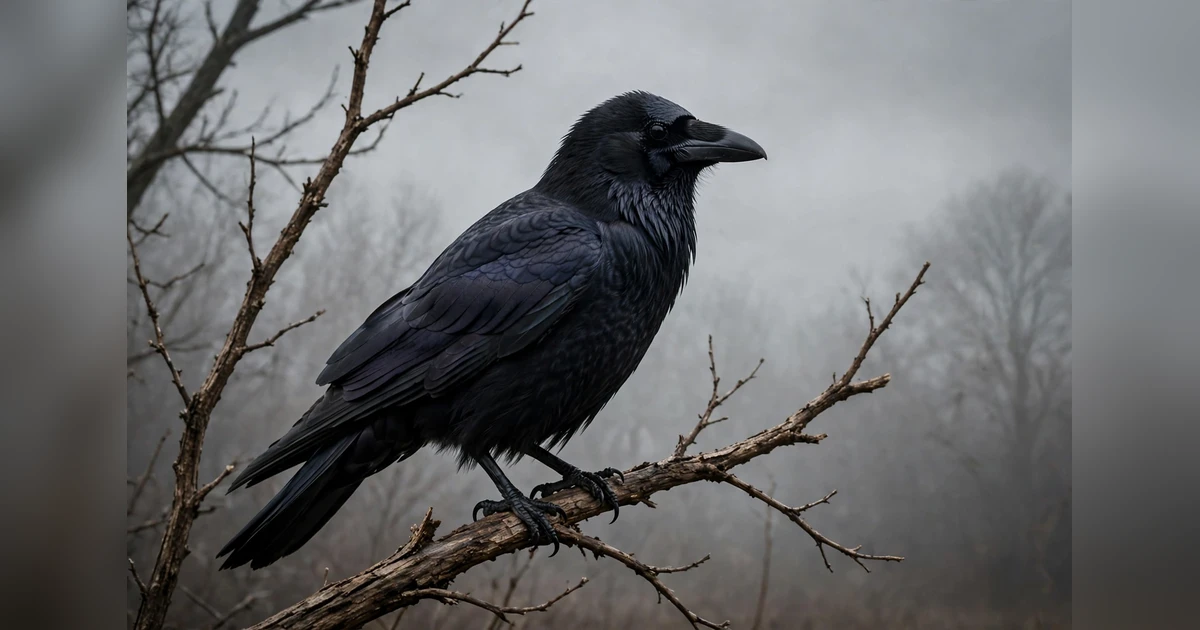
The rook, Corvus frugilegus, is the most abundant Eurasian bird of the crow family Corvidae. It is a large black bird, with a distinctive pale, bare face and a heavy bill, and it is found across Europe and Asia, in fields, woodlands, and farmland. Rooks are often confused with crows, but they are more social, more vocal, and more likely to be seen in large groups.
Like a color that changes with light, a rook changes with the sun, black in shade and shining blue-green in bright light. Its black plumage is not just black. In sunlight, it glints with purple, blue, and green, like oil on water. That hidden colour is part of the rook’s meaning: that what looks dark at first may hold light within it.
In nature, rooks are highly social creatures, living in large communities called rookeries, working together to find food and protect each other. A rookery is a colony of nests, often in the tops of tall trees, where dozens or hundreds of rooks live together, raise their young, and watch over each other. That community is the rook’s defining feature, and it is why the rook symbolizes cooperation, not isolation.
The Parliament of Rooks
A group of rooks is known as a parliament, due to their habit of forming large assemblies during which one bird will seem to address the others, while the rest listen in silence. That image, of rooks gathered like politicians, debating and listening, is one of the most charming in bird lore, and it is the source of the rook’s reputation as a bird of wisdom and of counsel.
The rook’s parliament is not just a story. Rooks really do gather in large groups, and they really do seem to take turns calling, as if they are speaking to each other. That behaviour is a sign of their intelligence: rooks are among the most intelligent birds in the world, capable of using tools, solving problems, and recognizing each other as individuals.
The parliament is also a symbol of community. A rook does not live alone. It lives in a rookery, it feeds in a flock, and it gathers in a parliament. Its life is a life of togetherness, and its meaning is a reminder that wisdom is not found alone. It is found in conversation, in listening, and in the company of others.
Hidden Knowledge and the Counting Rhyme
All of the crow family, rooks, crows, ravens, magpies, and jays, are associated with hidden knowledge and foretelling the future. The well-known counting rhyme, applied in different variants to both magpies and crows, is an example of this: One for sorrow, two for joy, three for a girl, four for a boy, five for silver, six for gold, and seven for a secret that cannot be told. As this rhyme makes clear, crows and their kin are augurs, keepers of secrets and mysteries.
The rook shares that reputation. In Celtic mythology, the rook is considered a guide to the otherworld, an escort for souls transitioning after death. In Greek mythology, rooks were said to be the messengers of Zeus, carrying news from the gods to the world of men. In Norse mythology, the rook, like other corvids, is connected to the god Odin, who was often depicted with two ravens, Huginn and Muninn, thought and memory, who flew across the world and brought him news.
The Roman author Suetonius recounts the tale of a prophetic crow, a pet of the Emperor Domitian, who could talk, but would only say “All will be well.” Because of their habit of saying “cras, cras,” meaning “Tomorrow, Tomorrow,” crows also became a symbol of hope, as well as procrastination. That double meaning, hope and delay, is part of the rook’s wisdom: that tomorrow will come, but that it is not today, and that waiting is both a virtue and a trap.
Death, Rebirth, and the Otherworld
The crow family is also associated with death, both because of their black feathers and their habit of feeding on carrion. Ravens and crows alike were considered to be incarnations of the Valkyries, Norse warrior goddesses that roamed the battlefield searching for the souls of the dead, and the raven was a symbol for the Morrigan, the Irish death-goddess.
The rook shares that association, but its meaning is softer than the raven’s. In Celtic mythology, the rook is often associated with death and rebirth. It is said to be a bringer of both good and bad news. The bird is also seen as a symbol of change and transformation. The rook is often seen as a guide to the otherworld. It is said to help souls find their way to the afterlife.
In Native American symbolism, the rook is considered a sacred creature. It is said to represent the cycle of life and death. The rook is also associated with change and transformation. That cycle, life to death to rebirth, is the rook’s deepest meaning: that death is not the end, but a passage, and that the rook, as a guide, helps souls make that passage.
In Christianity, the rook’s symbolism is often associated with sin and evil. It is said to represent the devil or Satan. That is a harsh reading, and it comes from the bird’s black colour and its association with death. But it is worth remembering that the same black colour, in other traditions, is a symbol of wisdom, of mystery, and of the unknown, not of evil. The rook’s meaning depends on who is looking at it.
Weather Lore: Rooks as Prophets of the Sky
Rooks have long been used as weather prophets, because their behaviour changes with the weather, and because farmers, who lived close to rooks, learned to read their signs.
Their nests are associated with the approach of summer, which if seen high in the tree-tops indicate fine weather, and low being wet and cold. Should the rooks suddenly leave the area it indicates that someone in the area is about to die and that no heir will be born in the family. In many European countries the rook is considered to bring good luck. To see a number of rooks perching together indicate that a storm is on the way.
That lore is a mix of observation and superstition, and it is important to separate the two. Rooks do build their nests high when the weather is fine, and low when it is wet, because they are responding to the wind and the rain. Rooks do gather before a storm, because they are seeking shelter. Those are real behaviours, and they are worth noticing. The idea that rooks leaving means a death in the family is a superstition, not a fact, but it shows how deeply rooks were woven into the lives of the people who lived beside them: their movements were read as messages, and their absence was felt as a loss.
Community, Cooperation, and the Rookery
When we talk about rook bird symbolism, two key elements come to the fore: community and transformation. Rook birds are highly social creatures. They live in large communities, known as rookeries, working together to find food and protect each other.
That community is a lesson. A rook does not survive alone. It survives because it lives with others, because it shares food, because it warns others of danger, and because it raises its young together with its neighbours. The rook’s meaning is therefore a reminder that we, too, need community, and that our strength comes not from isolation, but from cooperation.
The rook bird, with its striking black plumage and intelligent gaze, symbolizes community, transformation, and adaptability. As a totem, it brings forth lessons of cooperation, personal growth, and problem-solving. If a rook is your totem, you may be called to lead or teach others in difficult times. You are a symbol of strength and resilience, able to face any challenge head-on.
Rooks are also known for their adaptability. They live in cities as well as in the countryside, in fields as well as in forests, and they have learned to thrive in a world that is changing rapidly. That adaptability is a symbol of resilience: that we can change, that we can learn, and that we can survive, even when the world around us changes.
The Rook as a Totem and Spirit Animal
As a totem animal, the rook is a powerful symbol of adaptability and problem-solving. The rook bird spirit animal symbolizes strength, courage, and determination. The rook bird power animal is a symbol of protection.
If the rook is your spirit animal, it may mean that you are being called to use your intelligence, to solve a problem, or to lead others through a difficult time. The rook is a bird that thinks, that plans, and that works with others, and those are the qualities it teaches.
The rook’s totem meaning also includes change and new beginnings. Rook bird symbolism is often associated with change and new beginnings. Their symbolism and meaning can vary depending on culture, but they represent intelligence, change, new beginnings, and protection. A rook appearing in your life may be a sign that change is coming, and that you should embrace it, not fear it.
The Rook’s Call: What Does It Mean?
The most familiar sound associated with rooks is a harsh “caw” or “kraa” sound which often echoes over fields and woodlands where they forage. That call is not just noise. It is communication, and it carries meaning.
In many European folk traditions, rooks are associated with death or bad omens due to their black plumage and eerie calls echoing over battlefields or graveyards. The harsh “caw” of a rook was often interpreted as a portent of misfortune or death. In Celtic mythology, corvids like rooks were considered messengers between the mortal world and the afterlife. In medieval England, hearing a rook’s call near your home could be seen as a warning or an omen. However, not all associations were negative. Sometimes these birds were viewed as guardians watching over souls or protectors against evil spirits.
In Slavic traditions, rooks were sometimes linked with wisdom because of their social behaviour. In Norse mythology, while ravens were more prominent, like Odin’s Huginn and Muninn, rooks shared similar symbolic spaces as watchers or messengers. In Eastern Europe, the rook’s call could signal change or transition, reflecting its role in nature cycles.
Writers have long been fascinated by corvids’ evocative presence. The rook’s call appears frequently in poetry and literature symbolizing varied themes including mystery, death, intelligence, community, and sometimes melancholy. Victorian poets like Alfred Lord Tennyson referenced rooks’ cries as symbols of foreboding or looming change. Modern authors may use rook imagery to evoke atmosphere, darkness punctuated by sharp cries, as metaphors for communication breakdowns or collective consciousness.
Rooks in Literature and Culture
The rook appears in literature as a symbol of wisdom, of mystery, and of the passage of time. In the song “Rooks” by Shearwater, the rooks, swallows, gulls, and starlings, once symbols of freedom and vitality, now meet tragic ends, falling from the skies and perishing in various ways. This imagery serves as a metaphor for the fragility of life and the inevitable cycle of death. The falconer in the song wakes to the sound of bells, a symbol of change and warning, and the empty cages evoke a profound sense of loss.
That literary use of the rook is a reminder that the bird’s meaning is not fixed. It can be a symbol of wisdom, or a symbol of loss, or a symbol of change, depending on the story being told. The rook is a versatile symbol, and that versatility is part of its power.
There is one more rook worth mentioning, and it is not a bird at all. The rook in chess, the castle-shaped piece that moves in straight lines, shares the bird’s name, but its name comes from a different word: the Persian rukh, meaning chariot. That is a useful reminder that not every shared name is a shared meaning, and that the rook, the bird, stands on its own, without needing a chessboard to give it significance.
Rook in Dreams
Dreaming of a rook is a powerful symbol. It usually means change, or a message, or a need for wisdom. If you dream of a rook flying, it may mean that you are being called to use your intelligence, or that a change is coming, and that you should prepare for it.
If you dream of a parliament of rooks, a large group gathered together, it may mean that you need counsel, or that you should listen to others, or that a decision is being made that will affect you. The parliament in a dream is a reminder that you are not alone, and that wisdom is found in conversation.
If you dream of a rook’s call, a harsh caw in the night, it may mean a warning, or a message from the otherworld, or a reminder that something is about to change. The call is not necessarily a bad omen. It may be a call to pay attention, to listen, and to prepare.
Rook vs. Crow vs. Raven: How to Tell Them Apart
Rooks, crows, and ravens are often confused, but they are different birds, and their meanings are different too. Knowing the difference will help you read the sign correctly.
The rook is the most social of the three. It lives in rookeries, in large colonies, and it is rarely seen alone. Its face is pale and bare, its bill is heavy, and its call is a harsh, social caw. The rook’s meaning is community, cooperation, and collective wisdom.
The crow is more solitary. It lives in pairs or small family groups, and it is more likely to be seen alone, or with one or two companions. Its face is fully feathered, its bill is slimmer, and its call is a sharper, more individual caw. The crow’s meaning is intelligence, adaptability, and a cleverness that works alone.
The raven is the largest of the three, and the most solitary. It lives in remote places, in mountains and forests, and it is a bird of mystery and of the wilderness. Its call is a deep, resonant croak, and its meaning is magic, prophecy, and the unknown.
When you see a black bird, ask yourself: is it alone, or in a crowd? Is its face pale, or feathered? Is it calling to others, or calling to itself? The answers will tell you which bird you are seeing, and which message it carries.
Frequently Asked Questions
What does a rook symbolize?
A rook symbolizes wisdom, community, change, transformation, and hidden knowledge. It is a bird of the crow family, known for its intelligence, its social life in rookeries, and its association with the otherworld.
What is a parliament of rooks?
A group of rooks is known as a parliament, because of their habit of forming large assemblies during which one bird will seem to address the others. It is a symbol of community, counsel, and collective wisdom.
Is a rook a bad omen?
In some traditions, rooks are associated with death and bad omens, because of their black plumage and their calls over battlefields and graveyards. In many European countries, however, the rook is considered to bring good luck. The meaning depends on the culture and the context.
What is the difference between a rook and a crow?
Rooks are more social than crows, living in large colonies called rookeries, and they have a pale, bare face and a heavier bill. Crows are more solitary, and they have a fully feathered face. Both are members of the crow family, Corvidae.
What does the counting rhyme mean?
The counting rhyme, “One for sorrow, two for joy, three for a girl, four for a boy, five for silver, six for gold, and seven for a secret that cannot be told,” is applied to magpies and crows, and it reflects the belief that corvids are augurs, keepers of secrets and foretellers of the future.
What does a rook mean in Celtic mythology?
In Celtic mythology, the rook is a guide to the otherworld, an escort for souls transitioning after death. It is a bringer of both good and bad news, and a symbol of change and transformation.
What does it mean to dream of a rook?
Dreaming of a rook usually means change, a message, or a need for wisdom. A parliament of rooks in a dream means you need counsel. A rook’s call in a dream means a warning or a reminder to pay attention.
Final Thoughts
The rook is a bird that is often overlooked, in the shadow of its more famous cousins, the crow and the raven. But it deserves to be seen, because its meaning is unique: a bird of community, of wisdom, of change, and of hidden knowledge, that gathers in parliaments, lives in rookeries, and speaks in a harsh, honest voice.
The next time you see a rook, look at it closely. Notice its black feathers, and the way they shine blue-green in the sun. Notice its pale face, and its intelligent eye. Listen to its call, and ask yourself: what is it telling me? The answer may be wisdom. It may be change. It may be that you are not alone, and that your parliament is waiting for you. Or it may simply be that the world is full of intelligent, social, mysterious creatures, and that the rook is one of the best of them.