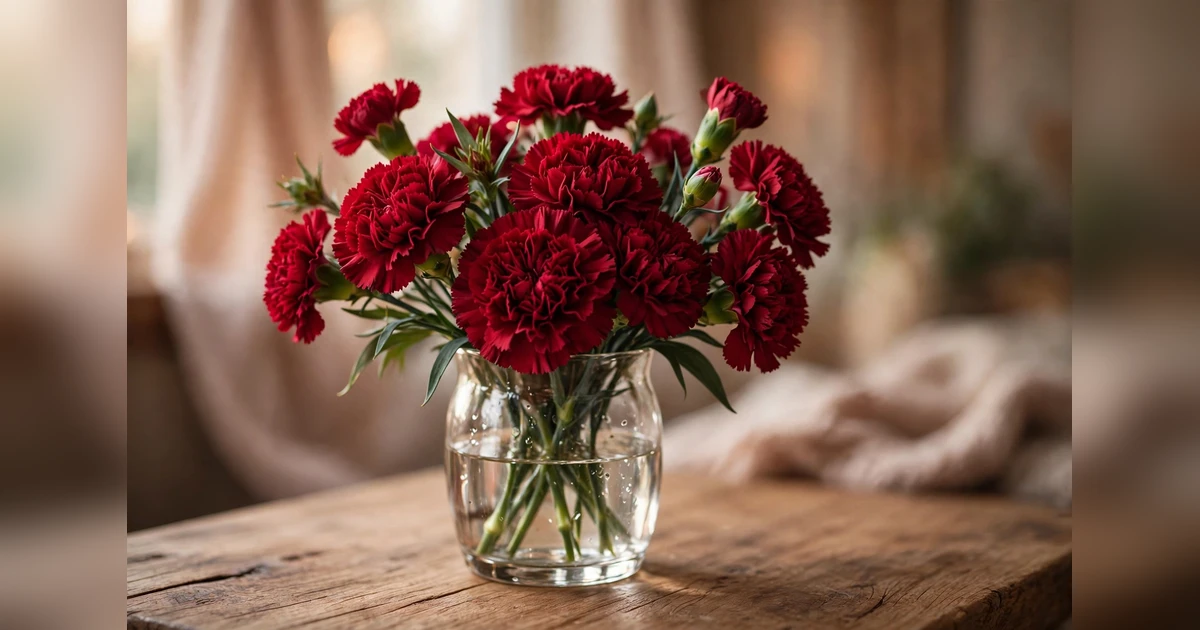
Red Carnation Symbolism: Deep Love, Admiration, and Devotion
A red carnation means deep love and admiration. It is a warm, steady flower, less dramatic than a red rose but no less sincere. Give it when you admire someone deeply, when you love them over a long time, or when you want to say thank you with feeling rather than with show. A light red carnation leans toward admiration and respect. A dark red carnation speaks of deeper, more passionate love.
Red carnations have carried this message for more than 2,000 years, from Greek and Roman ceremonies to Victorian flower language, from Mother’s Day to a peaceful revolution in Portugal. This guide explains what the flower means, how its shade changes the message, where it appears in history and culture, and when to give it.
The Short Answer: Deep Love and Admiration
Red carnations stand for love, fascination, and distinction. Those three words come from the Victorian language of flowers, called floriography, and they still fit the flower today. Love is the heart of the meaning. Fascination is the way the ruffled petals hold your eye. Distinction is the way the flower stands apart, not flashy, but memorable.
In everyday use, the message is simple. A red carnation says, “I admire you, and my feeling for you is real and lasting.” It works for romance, for a parent, for a mentor, and for a long marriage. It is softer than a red rose, so it can say love without saying urgency. It is stronger than a pink carnation, so it can say more than a gentle thank you.
What Is a Red Carnation?
The carnation is Dianthus caryophyllus, a member of the pink family. Its scientific name tells its story. Dianthus comes from Greek words meaning divine flower, or flower of the gods. Caryophyllus refers to its clove-like scent. Together, they describe a flower that people have treated as special for a very long time.
A red carnation has ruffled, fringed petals that look like folded silk. The stem is long and straight, the leaves are narrow and grey-green, and the flower can last two to three weeks in a vase, far longer than most cut flowers. That long life is part of its meaning. A flower that lasts becomes a natural symbol of love that lasts.
Carnations grow in many colors, and each color changes the message. White means purity and good luck. Pink means gratitude and a mother’s love. Yellow once meant disappointment or rejection in Victorian times, though today many people simply read it as cheerful. Purple means whimsy and unpredictability. Red stands at the warm end of the range, where love and admiration live.
Like a color that shifts with light, a red carnation shifts with shade. The same flower can speak softly or boldly, and the shade tells you which voice it is using.
Light Red vs Dark Red: The Shade Changes the Message
Shade matters with red carnations. A light red carnation, sometimes called a bright red, leans toward admiration, fondness, and respect. It is a good choice when you want to honour someone without declaring romance. Give it to a teacher, a mentor, a parent, or a friend whose work you respect.
A dark red carnation, sometimes called a deep red or burgundy red, leans toward deeper love and longing. Victorian floriography translated a red carnation as “my heart aches for you,” a rawer and more specific message than a red rose’s simple romantic love. A dark red carnation is the right choice for an anniversary, for Valentine’s Day, or for a partner you have loved for years.
A burgundy carnation, the darkest red of all, speaks of mature love, the kind that has grown over years and survived hard times. It is darker and more serious than bright red, which makes it a thoughtful choice for a long-term partner rather than a new romance.
When you choose, match the shade to the feeling. Light for admiration, dark for deep love, burgundy for love that has stood the test of time. If you are unsure, a medium red is safe. It carries both admiration and affection, and it rarely sends the wrong message.
A Short History: Greece, Rome, and Victorian Floriography
Carnations are among the oldest cultivated flowers in the world. Greek and Roman writers treated them as flowers of ceremony and devotion. The Romans are said to have carried carnations on campaigns, not as romantic tokens but as talismans of courage and enduring loyalty, a meaning that still lives in the red carnation today.
The name itself may come from the Latin carnis, meaning flesh, a reference to the flower’s original blush-pink colouring. Another theory links it to incarnation, tying the flower to themes of divine love and spiritual significance. Both stories point the same way: people have long seen something sacred in this ordinary-looking bloom.
In the nineteenth century, Victorian floriography gave every flower a message, and the carnation became a key player. Lovers, friends, and family members sent small bouquets that spoke in code. A red carnation said, “My heart aches for you.” A pink one said, “I will never forget you.” A white one said, “Pure love and good luck.” A striped carnation said, “I cannot be with you,” and a yellow one said, “You have disappointed me.”
That code has faded, but its core meanings remain.
Red Carnations and Mother’s Day
Red carnations have a special place in Mother’s Day. In 1908, Anna Jarvis founded Mother’s Day in the United States and chose the carnation, her mother’s favourite flower, as its emblem. White carnations honoured mothers who had died. Red carnations honoured mothers who were still living.
That distinction still guides many people today. A red carnation on Mother’s Day says, “I love you, and I am glad you are here.” A white carnation says, “I remember you, and I love you still.” The two colours together tell the whole story of a mother’s love, present and remembered.
Pink carnations also belong to Mother’s Day, because pink stands for a mother’s love and gratitude. Red adds admiration to that gratitude. If your mother is someone you admire as well as love, a red carnation is a fitting choice. It honours her as a person, not only as a mother.
Red Carnations Around the World
Red carnations travel well, and different cultures have given them different jobs.
In Portugal, the red carnation became a symbol of peace. In April 1974, during the Carnation Revolution, citizens placed red carnations in the barrels of soldiers’ rifles. The revolution was almost bloodless, and the flower became its emblem. Today, a red carnation in Portugal still carries that memory of peaceful change.
In South Korea, red and pink carnations are given on Parents’ Day on 8 May and on Teachers’ Day. They are symbols of love, gratitude, and respect for the people who raised and taught you. A child who gives a red carnation to a parent is saying thank you in the clearest way the flower language allows.
In parts of Europe, the red carnation has been worn as a lapel flower by socialist and labour movements, a symbol of solidarity and shared identity. That political use is separate from the romantic meaning, but it shows how strong the flower’s message is. A small red bloom can stand for a whole movement.
Red Carnations for Anniversaries and Romance
The red carnation is the traditional flower for a first wedding anniversary, and in some lists it is also named for a second anniversary. That tradition makes sense. A first anniversary is about a love that has survived its first year, and a red carnation, with its long vase life, is a fitting emblem for a love that lasts.
For romance, red carnations offer a quieter alternative to red roses. Roses can feel expected, even overdone. A red carnation feels considered. It says, “I thought about this, and I chose a flower that means admiration as well as love.” Many people find that message more personal than a dozen roses.
Give red carnations on Valentine’s Day when you want warmth without pressure, on an anniversary when you want to honour a shared history, or on a random day when you simply want to say, “I admire you.” A single stem can be enough. A small bunch, three to five stems, feels generous without feeling grand.
Red Carnations in Dreams and Spiritual Meaning
In flower symbolism, meanings that come from tradition are beliefs, not facts. That is true for dreams as well. A red carnation in a dream is often read as a sign of deep love, admiration, or longing. Some dream guides say it points to a relationship that matters to you, or to a feeling you have not yet spoken aloud.
In spiritual readings, red is the colour of the heart and of life force. Some stories say carnations grew from the tears of the Virgin Mary, which is why the flower is linked to a mother’s love. These readings are traditions, not facts.
Watch a red carnation in nature for a moment before you look up any meaning. Its ruffled petals, its steady stem, and its long life in the vase tell you more than any list can. It is a flower that stays, and that is its message.
When to Give Red Carnations, and When Not To
Red carnations suit many occasions. Give them on Valentine’s Day, on an anniversary, on Mother’s Day for a living mother, on Parents’ Day, on a birthday for someone you admire, or as a thank you to a mentor or a teacher. They also work as a sympathy flower when they are given with respect, because red can stand for admiration for a life well lived.
Do not give red carnations when the message could be misunderstood. A dark red carnation to a new colleague could read as romantic when you only meant respect. In that case, choose a light red, or choose a different colour altogether. A pink carnation is safer for gentle gratitude, and a white carnation is safer for pure respect.
Do not give them in a bouquet that mixes too many messages. A red carnation with a yellow carnation can confuse the reader, because the two colours once meant opposite things. Keep the bouquet simple, and the message will stay clear.
Cut the stems at an angle, keep them in clean water, and change the water every two or three days.
Frequently Asked Questions
What does a red carnation symbolize?
A red carnation symbolizes deep love and admiration. Light red leans toward admiration and respect, while dark red leans toward deeper, more passionate love.
Are red carnations romantic?
Yes, but they are warmer and gentler than red roses. A deep red carnation means love and admiration, so it works for romance and also for honouring someone you deeply respect, such as a parent or a mentor.
What is the difference between red and pink carnations?
Pink carnations mean a mother’s love and gratitude. Red carnations mean deep love and admiration. Pink is softer and more grateful. Red is stronger and more devoted.
Are red carnations for Mother’s Day?
Yes. Red carnations honour living mothers on Mother’s Day, a tradition that began with Anna Jarvis in 1908. White carnations honour mothers who have died.
Are red carnations the flower for a first anniversary?
Yes, the red carnation is the traditional flower for a first wedding anniversary, and in some lists it is also named for a second anniversary.
How long do red carnations last?
With clean water and a fresh cut, red carnations can last two to three weeks in a vase, far longer than most cut flowers.
Final Thoughts
A red carnation is a quiet flower with a loud heart. It does not shout like a rose, and it does not fade in a day like many blooms. It stays, it lasts, and it says, “I admire you, and I love you, and I mean it.”
When you give one, choose the shade with care, keep the message simple, and let the flower do its work. Light red for admiration, dark red for deep love, burgundy for love that has lasted. The person who receives it will feel the difference, even if they cannot name it.
For a deeper look at carnation meanings by colour, with history and a full colour guide, see this red carnation meaning guide. It covers the flower’s past, its colours, and when to give each shade.