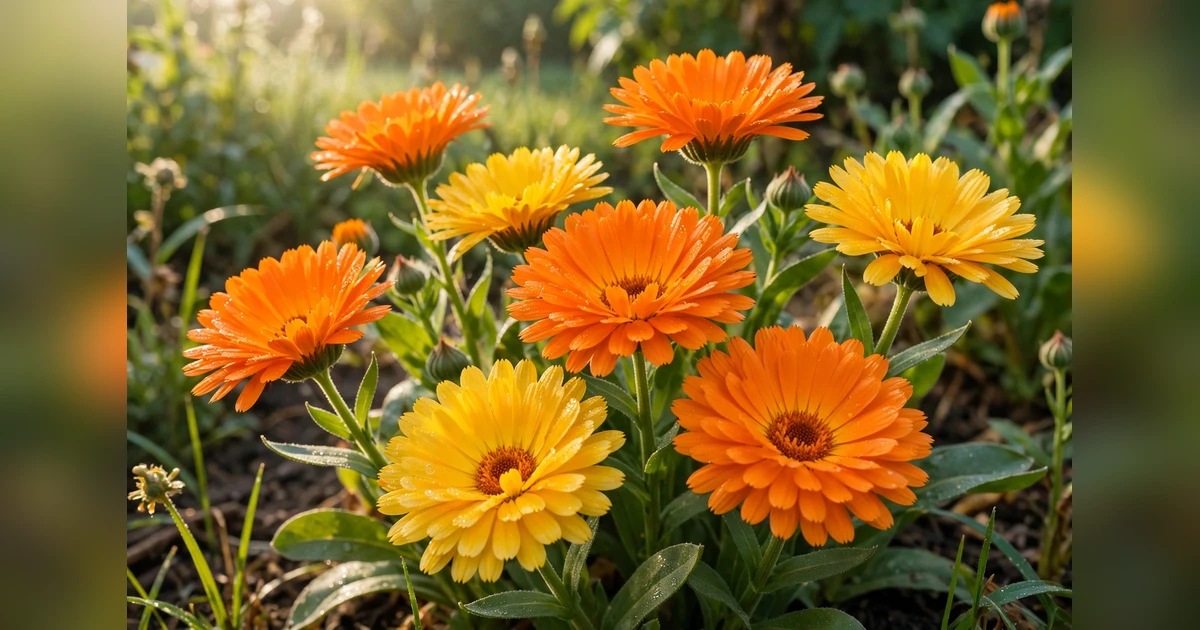
Calendula Symbolism: Meaning, Healing, and the Bride of the Sun
Calendula symbolizes joy, healing, resilience, and protection. It is a flower of the sun: bright orange and yellow, opening its petals at dawn and closing them at dusk, following the sun across the sky like a lover following a beloved. For centuries, across Greek, Roman, and Christian traditions, calendula has meant the same things: happiness, grace, healing, and a light that returns every morning, no matter how dark the night was.
Calendula, also known as pot marigold, is a beautiful flower that is often used for ornamental purposes. However, beyond its aesthetic value, calendula holds significant spiritual meaning. Its petals radiate outward from the centre in a way that genuinely resembles the sun. That is not a poetic observation. It is a structural fact, and it explains almost everything about what this flower has meant to people for centuries.
What Is Calendula?
Calendula officinalis belongs to the Asteraceae family and differs in about 20 varieties, though the family as a whole has around 15 species of calendula. It is a hardy garden flower, easy to grow, and beloved by gardeners for its bright colours and its long blooming season.
The name calendula comes from the Latin word calendae, meaning “first day of the month,” because in the warm Mediterranean climate the colourful blooms were always present, and the flower could be seen on the first day of each month, the calends. The Romans observed that the flowers were in bloom on the first day, or calends, of every month, and so named them. That name is a promise: that calendula is always there, always blooming, always returning.
In nature, calendula is a hardy garden flower that blooms through the summer, opening each morning and closing each evening, and returning the next day regardless of conditions. That resilience is part of its meaning: a flower that opens each morning, closes each evening, and returns the following day regardless of conditions carries that message in its biology.
Like a color that changes with light, calendula changes with the sun, gold in the morning and deep orange at dusk. Its colours are yellow and orange, which represent the path of the sun throughout an autumn day. It is thought that the flower holds all of the sunlight of autumn.
The Bride of the Sun: Calendula and the Sun
Calendula officinalis is heliotropic: it tracks the sun across the day, opening its petals at dawn and closing them at dusk. The flower became a living symbol of solar energy because it behaved like one. Peasant tradition says that if this flower, which normally opens in the morning and closes in the evening, does not open its corolla to the sun, the day will turn ugly: a hint of rain on the horizon.
In medieval texts, marigold is called Solis sponsa, “bride of the sun.” That name captures the flower’s most romantic meaning: that calendula is married to the sun, that it follows the sun, and that it cannot live without the sun’s light. The poet Keats referred to calendula as “Apollo’s eye,” Apollo being the Greek god of the sun, and that name, too, captures the flower’s solar nature: it is the sun’s eye, watching the world, and shining its light back.
In ancient Greece and Rome, calendula was a symbol of the sun, and it was believed to possess healing properties. The Greeks and Romans read calendula as a sign of love and devotion. It appeared at weddings and seasonal festivals across both cultures, because the sun is the source of life, and calendula, as the sun’s flower, is a symbol of life itself.
Mary’s Gold: Calendula in Christianity
During the Middle Ages, Christian symbolism absorbed calendula entirely. The flower became known as Mary’s Gold, and marigold is a direct contraction of that name, and it was associated with the Virgin Mary in religious art and ceremony.
The calendula was used by the early Christians who would place this beautiful, bright flower next to statues of the Virgin Mary. They called it Mary’s Gold, perhaps because of the calendula infusion’s ability to relieve menstrual pain, thus linking it to the feminine element, the Great Mother. It is no coincidence that its hooked seed resembles a crescent moon, which par excellence in archetypes is the feminine symbol, those of woman opposite the sun, a masculine element.
In Christianity, calendula is associated with the Virgin Mary and is used to symbolize her purity. That is a beautiful paradox: a flower of the sun, bright and bold, becomes a symbol of purity, because its gold is the gold of heaven, not of earth. Mary’s Gold is not the gold of wealth. It is the gold of grace.
Aphrodite and Adonis: The Legend of Grief
The notion that marigold is also a symbol of submission and pain is owed to an ancient Greek legend that tells that Aphrodite grew up with Adonis, the son of Myrrh and Thia, as his mother Myrrh for a punishment inflicted by the gods had been turned into a tree.
Zeus decided that Adonis from then on would spend part of the year with Aphrodite, among the living, and the other half with Proserpine, among the dead. But when Adonis returned to the Underworld, Aphrodite wept bitterly and from her tears was born a Marigold plant that, like Adonis, would be destined for periods of life alternating with periods of death. That legend gives calendula its saddest meaning: that joy and grief are intertwined, and that a flower can be born from tears.
This conception of grief and resentment still exists. In fact, Mexicans associate marigold with death, on a par with chrysanthemum, partly as a function of a local legend that the flower came to Mexico brought by conquistadors, where it developed because of the blood spilled by indigenous people, victims of white colonization. But it is important to be honest here: the marigolds of Mexico’s Day of the Dead, and those strung at funerals and festivals across South Asia, are Tagetes, a different genus that shares the common name but not the plant. Calendula officinalis and Tagetes are cousins, not twins, and their meanings, while related, are not identical.
The English associate calendula with jealousy: folk tradition holds that spinsters, having never been loved by anyone, turn into yellow marigolds from anger when they die. That is a harsh legend, but it shows how deeply calendula is woven into the emotional life of ordinary people: it is a flower of love, of loss, and of the anger that comes when love is denied.
Joy, Happiness, and Grace
Calendula symbolizes happiness, joy, grace, and sometimes grief and loss. The calendula plant or flower has been a symbol of fire and sunshine for many centuries. Its bright orange colour is associated with joy and happiness. The flower is believed to bring positive energy and uplift one’s mood.
In the Victorian language of flowers, calendula carried specific meanings that drew on the full weight of its earlier symbolic history. Joy and warmth were the primary associations: sending calendula meant wishing the recipient happiness and brightness. The Victorians’ hidden message in sending the calendula flower was, “My thoughts are with you.” In the language of flowers the calendula flower means “winning grace.”
In China, calendula represents joy and happiness. In India, people traditionally included calendula flowers in wedding decorations to symbolize passion, fertility, and creativity for the new couple. Lakshmi and Ganesh were mainly connected with the energies of calendula, which included wishes for wealth, health, and business success. That is a wide range of meanings, from joy to wealth, and they all come from the same source: the sun, and the light that calendula carries.
Healing: The Medicine of the Sun
In ancient times, calendula was believed to have powerful healing properties. The flower was used to treat wounds, cuts, and bruises. Its bright orange colour was thought to be a symbol of vitality and regeneration. Ancient Egyptians are said to have believed marigold was capable of rejuvenation, while Hindus employed it to adorn temples and the Persians and Greeks used the petals to decorate food.
Calendula tea can be used for gastritis, and a warm gargle has been used to soothe canker sores. The tea has also been recommended for women with painful menstruation or menopausal problems. That medicinal use is part of calendula’s symbolism: it is a flower that heals, and its healing is a symbol of the sun’s power to restore life.
Modern herbal medicine still uses calendula for skin: for cuts, for burns, for rashes, and for wounds that are slow to heal. The flower’s bright colour is a reminder of its purpose: to bring light to a wound, and to help the body heal itself. Calendula is a symbol of healing because it is a healer, and its healing is not just symbolic. It is real.
Protection and Folk Magic
Calendula is believed to be a protective flower that can ward off negative energies and evil spirits. In some cultures, the flower is used for spiritual cleansing and clearing negative energy. In folk magic across Europe, it protected homes and purified spaces.
Calendula is supposed to be good for legal purposes. Carry a flower in your pocket when you go to court. Calendula in the bath makes people admire you, good for before job interviews and other occasions when you want to be seen in a good light. That folk magic is a reminder that calendula is not just a flower of the garden. It is a flower of everyday life, used by ordinary people for ordinary problems: a court case, a job interview, a need for protection.
According to the 12th century Macer’s Herbal, calendula should be picked when the moon is in Virgo but not when Jupiter is in the ascendant, by someone fasting and recently cleansed of sin, who recites three Our Fathers and three Hail Marys. In the 16th century, it was believed that a calendula concoction enabled one to see fairies. Those old rules may seem strange today, but they show how seriously people took calendula: it was not just a flower. It was a sacred plant, with rules for its gathering, and powers for those who used it correctly.
Grief, Remembrance, and the October Flower
Grief and remembrance were a secondary register in calendula’s Victorian meaning. The marigolds of Mexico’s Day of the Dead are Tagetes, but calendula shares their association with the dead, because its bright colours offer comfort in the season of dying. The Victorians related calendula with October, underscoring the symbolism calendula has with funerals and death and the idea of the sun’s glide across the sky. Calendula’s bright-coloured blossoms offered comfort and warmth as the world moved into the dark, cold months of winter.
The calendula is the flower for those with a birthday in the month of October. That makes it a birth flower, a symbol of the people born in the autumn, when the light is fading but the colours are at their brightest. An October birthday, with calendula as its flower, is a reminder that even as the year dies, there is still beauty, still warmth, and still light.
The symbolic meaning of the calendula flower is grief, despair and sorrow, in one tradition, and joy and happiness in another. That contradiction is the flower’s truth: that calendula holds both meanings at once, because life holds both meanings at once. A flower that blooms in the autumn, when the year is ending, is a flower of both joy and grief, and it does not choose between them.
Calendula in Different Cultures
In Hinduism, marigold flowers are used for spiritual purification and offerings to the gods. Temples are adorned with marigolds, and the flowers are strung into garlands for festivals, weddings, and funerals. The marigold is a flower of celebration and of devotion, and its bright colour is a symbol of the divine light.
In Mexico, calendula is used for Day of the Dead celebrations, though the flowers used there are Tagetes, the Mexican marigold. The flower is believed to represent the sun and is used to honour deceased loved ones. The bright orange petals are said to guide the spirits of the dead back to the world of the living, like a path of sunlight.
In China, calendula represents joy and happiness, and it is given as a gift to wish someone a bright future. In England, calendula is a flower of the garden, and of folk tradition, associated with jealousy, with grief, and with the sun. In each culture, calendula means something slightly different, but the core is the same: a flower of the sun, of joy, and of light.
Calendula in Dreams
Dreaming of calendula is a positive sign. It usually means joy, healing, and a new beginning. If you dream of calendula blooming, it may mean that your life is about to brighten, that a difficult time is ending, and that the sun is about to rise again.
If you dream of receiving calendula, it may mean that someone is thinking of you, because the Victorian message of calendula is “My thoughts are with you.” The dream is a reminder that you are loved, and that someone’s thoughts are with you, even when they are far away.
If you dream of calendula wilting, it may mean grief, or a loss, or a time of sadness. But calendula is a flower that returns every morning, and the dream is a reminder that grief, like the flower, is not permanent. The sun will rise again, and the flower will open again.
Calendula in the Garden: Growing the Sun’s Flower
Calendula is one of the easiest flowers to grow, and that ease is part of its symbolism. It does not demand much: a sunny spot, well-drained soil, and a little water, and it will bloom for months, from early summer into the autumn. It is a flower for beginners, and for people who have never grown anything before, because it forgives mistakes and rewards even a little care.
To grow calendula, sow the seeds in spring, after the last frost, in a sunny place. The seeds are curved, like a crescent moon, and they germinate quickly. Thin the seedlings so that each plant has room to grow, and water them when the soil is dry. Deadhead the spent flowers, removing them so that the plant puts its energy into new blooms, and the plant will flower again and again, until the first hard frost.
Calendula is also a companion plant, which means it helps other plants grow. It attracts pollinators, like bees and butterflies, and it repels some pests, like aphids and whiteflies. Gardeners plant calendula near vegetables, not just for its beauty, but for its protection: it is a flower that guards the garden, just as it is said to guard the home.
Growing calendula is a way of bringing the sun into your garden, and into your life. Each morning, when the flowers open, they are a reminder that the day has begun, and that light has returned. Each evening, when they close, they are a reminder that rest is also a part of life. And each year, when they return, they are a reminder that what dies can be reborn, and that the sun always comes back.
Frequently Asked Questions
What does calendula symbolize?
Calendula symbolizes joy, healing, resilience, protection, and grace. It is a flower of the sun, and it also carries meanings of grief and remembrance, because it blooms in the autumn and is associated with funerals and the dead.
Why is calendula called Mary’s Gold?
Calendula is called Mary’s Gold because early Christians placed it next to statues of the Virgin Mary. Marigold is a direct contraction of Mary’s Gold, and the flower became a symbol of the Virgin’s purity and grace.
What does calendula mean in the Victorian language of flowers?
In Victorian flower language, calendula meant “My thoughts are with you” and “winning grace.” It was sent to wish someone happiness, and it was also used in arrangements for loss and grief.
Is calendula the same as marigold?
Calendula officinalis is called pot marigold, but it is not the same as the Mexican marigold used in Day of the Dead celebrations, which is Tagetes, a different genus. They share the common name marigold, but they are different plants.
What is calendula used for in healing?
Calendula has been used for centuries to treat wounds, cuts, bruises, and skin problems. Its tea has been used for gastritis, canker sores, and menstrual pain. Modern herbal medicine still uses it for skin healing.
What does it mean to dream of calendula?
Dreaming of calendula usually means joy, healing, and a new beginning. Receiving calendula in a dream means someone is thinking of you. A wilting calendula can mean grief, but also the promise that the sun will rise again.
When does calendula bloom?
Calendula blooms through the summer and into the autumn, and in warm Mediterranean climates, it can bloom on the first day of every month. Its name comes from the Latin calendae, the first day of the month.
Final Thoughts
Calendula is a flower of the sun, and it is a flower of the heart. It opens each morning, closes each evening, and returns the next day, regardless of conditions. That is its message: that light returns, that healing is possible, and that joy is not a single moment, but a practice, repeated every day.
Whether it is called Mary’s Gold, the bride of the sun, or Apollo’s eye, calendula is a flower that has been loved for centuries, by Greeks and Romans, by Christians and Hindus, by Victorians and by gardeners. It is a flower of joy and of grief, of healing and of protection, of love and of loss. It holds all of those meanings at once, because it is a flower of the sun, and the sun holds all of them too.
The next time you see calendula, look at the way its petals radiate outward, like the rays of the sun. Remember that it opens each morning, and that it will open again tomorrow. And carry its message with you: that the sun always returns, and that so will you.