Symbolism in Beowulf: Heorot, Grendel, and the Dragon
Beowulf is a poem built on symbols: a hall that stands for civilization, monsters that stand for evil and death, and a treasure that stands for the vanity of human wishes. The Old English epic, written more than a thousand years ago, tells the story of a hero who fights three monsters, but it is also a story about light and darkness, about community and loneliness, about glory and mortality, and about what lasts when everything else fades. To read Beowulf is to read a poem in which every place, every object, and every monster means something more than itself.
Beyond battles and heroes, Beowulf uses symbols to deepen meaning, exploring good, evil, glory, greed, and time. Here are the symbols that matter most, and what they mean.
What Is Beowulf?
Beowulf is the oldest surviving epic poem in the English language, written in Old English, in the language of the Anglo-Saxons, sometime between the seventh and tenth centuries. It is 3,182 lines long, and it is written in a style distinguished by its heavy use of alliteration, in which words that begin with the same sound are placed close together, like “shield” and “sheafson,” or “hall” and “hart.”
The poem tells the story of Beowulf, a warrior from Geatland, who travels to Denmark to help King Hrothgar, whose great hall, Heorot, is attacked every night by a monster named Grendel. Beowulf kills Grendel, then kills Grendel’s mother, then returns home, becomes king, and, fifty years later, fights a dragon, and dies. That is the story, but the poem is also a meditation on what it means to be a hero, what it means to be mortal, and what it means to live in a world where darkness is always waiting outside the hall.
Heorot: The Mead Hall as Civilization
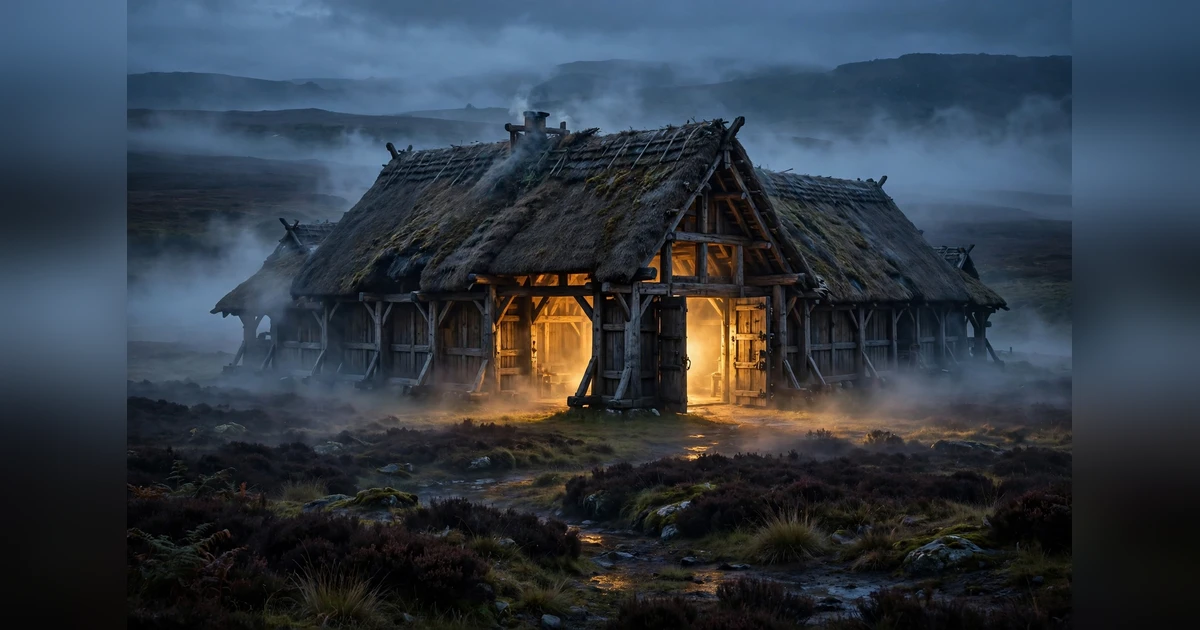
Hrothgar’s great mead-hall, Heorot, meaning “Hall of the Hart,” functions as both setting and symbol in the epic. Symbolically, Heorot represents the achievements of the Scyldings, specifically Hrothgar, and their level of civilization. The hall is a home for the warriors who sleep there and functions as a seat of government. It is a place of light, warmth, and joy, contrasting with Grendel’s morbid swamp as well as the dark and cold of winters in Scandinavia.
The great hall built by King Hrothgar is more than just a building. It stands for everything good about human society. Inside its walls, people gather to feast, share stories, exchange gifts, and celebrate together. It represents warmth, community, light, and order in a dangerous world. That is exactly why Grendel attacks it: he hates the joy and unity it represents. The hall becomes a symbol of civilization, standing bravely against the darkness that surrounds it.
Like a color that changes with light, Heorot changes with the hour, golden and joyful by day and dark and fearful by night. During the day, Heorot is a happy, celebratory place. However, during the night, it becomes a place that no one, but the most courageous warriors such as Beowulf, would dare step foot in, due to a monster, Grendel, coming to Heorot every night and eating anyone there. Looking beyond the surface, Heorot is more than just a place that men drink at during the day and Grendel fills his belly at nights. It represents the achievements of the Danish, being a palace full of rich gifts, of song, and of fellowship.
Heorot was built to honor Hrothgar and his greatness as a king. It is supposed to be a hall where many warriors can meet and celebrate their deeds. The hall represents the glory and legacy of kings, in which the legends of their culture tell of how they struggle and rise as heroes and warriors. That is why its vulnerability matters: Heorot’s vulnerability to attack by Grendel and his mother emphasizes the fragility of human achievements and the impermanence of safety and peace. A hall can be built, but it can also be attacked. Civilization can be built, but it can also be broken.
Grendel: Evil, Chaos, and the Outcast
Grendel, a primary antagonist in the epic poem Beowulf, is a monstrous creature descended from the biblical Cain, symbolizing irredeemable evil, chaos, and violence. Cain, in the Bible, was the first murderer, who killed his brother Abel, and who was cursed by God to wander the earth. Grendel, as a descendant of Cain, carries that curse, and he is an outcast, a creature who lives outside the hall, in the darkness, and who hates the light and joy inside it.
Grendel represents human flaws such as jealousy and anger, linked to his descent from Cain. He is jealous of the joy in Heorot, angry at the song and the feasting, and he comes every night to kill, because he cannot bear to hear happiness that he cannot share. That is a human flaw, and it is one that the poem understands: that evil is not always a monster from outside. Sometimes, it is jealousy, it is anger, and it is the pain of being excluded, turned into violence.
According to the writer and theorist John Gardner, who wrote an alternative version of this story which focuses on Grendel, humans create monsters because of something dark and lurking we see in ourselves, something horrible yet seductive. Grendel is perhaps the perfect example of this idea. He is descended from Cain, one of the first humans in the Bible, and he is a mirror of the darkness that lives in all of us.
Grendel’s Claw, Arm, and Head: The Trophy
After Beowulf’s battle with Grendel, he hangs Grendel’s claw, arm, and shoulder from the rafters of Heorot. This trophy serves not only as a symbol of Beowulf’s victory and strength but also as a public testament to his heroic deed. The claw, hanging in the hall, is a sign that the monster is dead, that the hall is safe, and that Beowulf is a hero.
Grendel’s head, which Beowulf is able to find after a strange, perhaps holy brilliance illuminates the dimly lighted cave, is much more impressive. He ignores the vast treasure in the cave, instead choosing to carry the magnificent, huge head as symbolic of his victory over both ogres. Grendel’s mother also sees it as a symbol, representing her personal loss and mankind’s macabre sense of what might be an appropriate trophy.
That trophy is a double symbol. For the Danes, it is a sign of victory, of safety, and of Beowulf’s strength. For Grendel’s mother, it is a sign of loss, of grief, and of a son who will never come home. The same object can mean two things, and the poem knows that: that victory for one person is loss for another, and that a trophy is also a reminder of death.
The Cave and the Mere: The World of Outcasts
The cave where Grendel and his mother hide from the world is symbolic of their lives as outcasts. The cave also represents their heritage. When Grendel’s mother is able to fight Beowulf in the cave, she has a distinct advantage. His victory is all the more significant. The cave itself represents a world alien to Heorot. One is high and bright and full of song and joy, towering as the Scyldings’ greatest achievement. The other is dark and dank and full of evil, beneath a mere in the middle of a fen and the symbolic home of resentful outcasts.
Grendel’s mother’s lake, in contrast to Heorot, is a symbol of death. The first sight of the lake is the beheaded Danish advisor of Hrothgar. The lake itself is filled with items and creatures symbolic of death, and it is a place where the water crawls with things that should not be there. The lake itself is filled with symbols of rushed death which contrast Heorot, a symbol of life. That contrast, Heorot as life and the mere as death, is the poem’s central image: that the world is divided into light and dark, into hall and fen, into community and exile, and that the hero must travel between them.
Water is commonly tied to the fighting of monsters. It always ends up as a bloody mess. At the end of each chase, there is water involved. Water stands for life and blood and birth, associates with femininity. It cleanses Beowulf and strengthens him. Water is also the seductress, leading to ruin as seen in sirens and the call to the sea. That double meaning, water as life and water as death, is part of the poem’s wisdom: that the same thing can give life and take it away, and that the hero must be careful, even in victory.
Grendel’s Mother: The Avenger
Grendel’s mother embodies the concept of the avenger, a common motif in Old English literature, as she seeks to avenge the death of her son. She is not just a monster. She is a mother, grieving for her child, and her grief makes her dangerous. That is a human emotion, and it is one that the poem treats with seriousness: that a mother’s grief can be as powerful as a warrior’s rage, and that revenge is a cycle that does not end.
Grendel’s mother represents the hero’s darkest challenge, akin to Joseph Campbell’s “belly of the whale” concept, marking Beowulf’s emergence as a true hero. The belly of the whale is the moment in a hero’s journey when the hero is swallowed, when he is in darkness, and when he must find a way out. Beowulf’s descent into the mere, into Grendel’s mother’s cave, is that moment: he goes down into the water, into the dark, and he must fight his way out, alone, with a sword that fails him, and with only his own strength to save him.
Beowulf is also challenged by feminine symbols: the cup offered by Wealhtheow, Hrothgar’s queen, and the water into which Grendel’s mother retreats. He wins the male challenges easily, but he struggles with the female ones, and that struggle shows how deeply the poem’s symbols are woven into its ideas about gender, power, and the hero’s journey.
The Dragon: Mortality and the End of Heroes
The dragon is an ancient, powerful serpent, and it guards a hoard of treasure in a hidden mound. The dragon almost tells a different story entirely, the story of a great man meeting his unavoidable end. Grendel represents human flaws, Grendel’s mother represents the hero’s darkest challenge, and the dragon symbolizes mortality and the inevitability of death, underscoring the limits of human strength.
The dragon is nearly identical to the modern dragon, being the basis for our current image. Like in Harry Potter and Tolkien’s Hobbit, the dragon looks the same and is chained to gold underground. The dragon is similar to Grendel in that Beowulf does not protect his slaves, and thus the dragon is brought upon them. That is a reminder that the dragon is not just a monster. It is a consequence, a result of human actions, and a symbol of what happens when a king fails to protect his people.
Hrothgar gives advice to Beowulf. He says not to forget that you are mortal, and that too many great things will happen to Beowulf so that he will be comfortable and forget about dangers and death will come to claim him. Thus a dragon comes. The text intends to say that pleasures of the mortal soul will poison the life after death. Beowulf has to die at the end because he needs sin, so that there is still a king, and therefore needs a dragon. That is a complex reading, but it captures the poem’s central truth: that even the greatest hero must die, and that death is not a failure. It is the end of every story.
The Dragon’s Treasure: Greed and Vanity
The dragon’s treasure-trove poignantly represents the vanity of human wishes as well as the mutability of time. The dragon’s barrow holds wealth in abundance, yet the wealth is of no use to anyone. The hoard of gold guarded by the dragon is a striking symbol with two meanings. On one hand, it represents the glory and reward a hero can win. On the other hand, it stands for greed and the emptiness of riches. The treasure is ancient and cursed, buried by a long-dead people, and it brings only destruction to those who disturb it. After Beowulf dies, winning it, the gold is buried with him, never used.
In nature, the dragon’s treasure is like gold in the earth, beautiful, ancient, and useless to anyone who cannot use it. That is the treasure’s lesson: that wealth, on its own, is nothing, and that gold, buried in a mound, is no better than stone. The dragon’s treasure is a symbol of greed, of the desire for wealth that brings only destruction, and of the vanity of human wishes: that we want things that we cannot use, and that we die trying to get them.
A slave steals a treasure from the dragon, and that theft is what wakes the dragon and brings destruction to Beowulf’s kingdom. That is a small act, with great consequences, and it is a reminder that greed, even in small amounts, can bring ruin. The dragon’s treasure is not just gold. It is a warning.
Swords, Cups, and Christian Symbols
Sword references relate back to Christianity. The battles in which Beowulf uses one show how he feels about each situation. When Beowulf fights Grendel, he fights with his bare hands, because Grendel has no sword, and because Beowulf wants to prove his strength. When he fights Grendel’s mother, his sword fails him, and he must use a giant’s sword, hammered by giants, strong and blessed with their magic, the best of all swords, which he finds hanging on the wall of the cave. That sword is a symbol of divine help, of a weapon that comes from beyond the human world, and of the idea that the hero cannot win alone.
The cycle of violence continues until a different approach to ruling takes over: Christianity. This is all in waiting for the “true” king to surpass them all, the Messiah. In this Christian text, this means Jesus Christ, and because Christ is not traveling to the Geats to be their king 500 years after his death, it means his word and his message is coming to them. That is a Christian reading of the poem, and it shows how the poem, which is set in a pagan world, was written by a Christian poet, who saw the old heroes as waiting for a new kind of king.
The phrase “shepherd of people” has been read as a reference to Jesus, and Beowulf himself has been read as Moses, saving his people. Those readings are interpretations, not facts, but they show how rich the poem’s symbolism is: that it can be read as a pagan epic, as a Christian allegory, and as a story about power, leadership, and what it means to be a good king.
The Burial Mound: Fame and Mortality
Beowulf’s burial mound, built on a sea cliff, captures both the hero’s lasting fame and the sadness of mortality. It fulfills his wish to be remembered but also stands as a tomb, showing that even the greatest hero must die. It symbolizes the desire to leave a mark after death.
Beowulf asks to be buried in a mound on a cliff, where sailors can see it, and where his name will be remembered. That mound is a symbol of fame, of the desire to be remembered, and of the hero’s belief that his deeds will outlive him. But it is also a tomb, a place of death, and a reminder that even the greatest hero is mortal. The mound is both a monument and a grave, and that double meaning is the poem’s final symbol: that fame and death are two sides of the same coin, and that the hero’s story ends, as all stories do, in silence.
Light and Darkness
The poem’s most important symbol is not a place or an object. It is light itself. Heorot is light, warmth, and joy. Grendel’s swamp is darkness, cold, and evil. The dragon’s barrow is darkness. The burial mound is on a cliff, where it catches the light. That contrast, between light and dark, runs through the whole poem, and it is the poem’s way of saying that the world is divided, and that the hero’s job is to bring light into the dark, even if only for a time.
Frequently Asked Questions
What does Heorot symbolize in Beowulf?
Heorot, the mead hall built by King Hrothgar, symbolizes civilization, community, light, warmth, and order. It is a place of feasting, storytelling, and fellowship, and it stands against the darkness outside. Its vulnerability to Grendel’s attacks also symbolizes the fragility of human achievements.
What does Grendel symbolize?
Grendel, descended from the biblical Cain, symbolizes irredeemable evil, chaos, violence, jealousy, and anger. He is an outcast who hates the joy in Heorot, and he represents the darkness that lives outside civilization, and the darkness that lives inside all of us.
What does Grendel’s mother symbolize?
Grendel’s mother embodies the avenger motif, seeking revenge for her son’s death. She represents the hero’s darkest challenge, the “belly of the whale” in the hero’s journey, and the power of grief and revenge.
What does the dragon symbolize?
The dragon symbolizes mortality and the inevitability of death, underscoring the limits of human strength. It also guards a treasure that symbolizes greed and the vanity of human wishes.
What does the dragon’s treasure symbolize?
The dragon’s treasure symbolizes greed, the emptiness of riches, and the vanity of human wishes. It is ancient, cursed, and buried, and it brings only destruction to those who disturb it. After Beowulf dies, the gold is buried with him, never used.
What does Beowulf’s burial mound symbolize?
The burial mound, built on a sea cliff, symbolizes both the hero’s lasting fame and the sadness of mortality. It fulfills his wish to be remembered, but it also stands as a tomb, showing that even the greatest hero must die.
What do swords symbolize in Beowulf?
Swords in Beowulf relate to Christianity and to divine help. Beowulf’s own sword fails him against Grendel’s mother, and he must use a giant’s sword, blessed with magic, which he finds in the cave. That sword is a symbol of help from beyond the human world.
Final Thoughts
Beowulf is a poem that has survived for more than a thousand years, and it has survived because its symbols are still true. Heorot is still a symbol of community, of light, and of what we build together. Grendel is still a symbol of jealousy, of anger, and of the darkness that hates joy. The dragon is still a symbol of death, and of the limits of human strength. And the burial mound is still a symbol of fame, and of mortality, and of the desire to be remembered.
The next time you read Beowulf, look for the symbols. Notice the hall, the cave, the treasure, and the mound. Ask yourself: what do they mean? The answer may be civilization, evil, greed, or death. Or it may simply be that the world is full of light and darkness, and that the hero’s job, then as now, is to bring light into the dark, even if only for a time.