Birds Flying in a Circle: Meaning, Science, and Symbolism
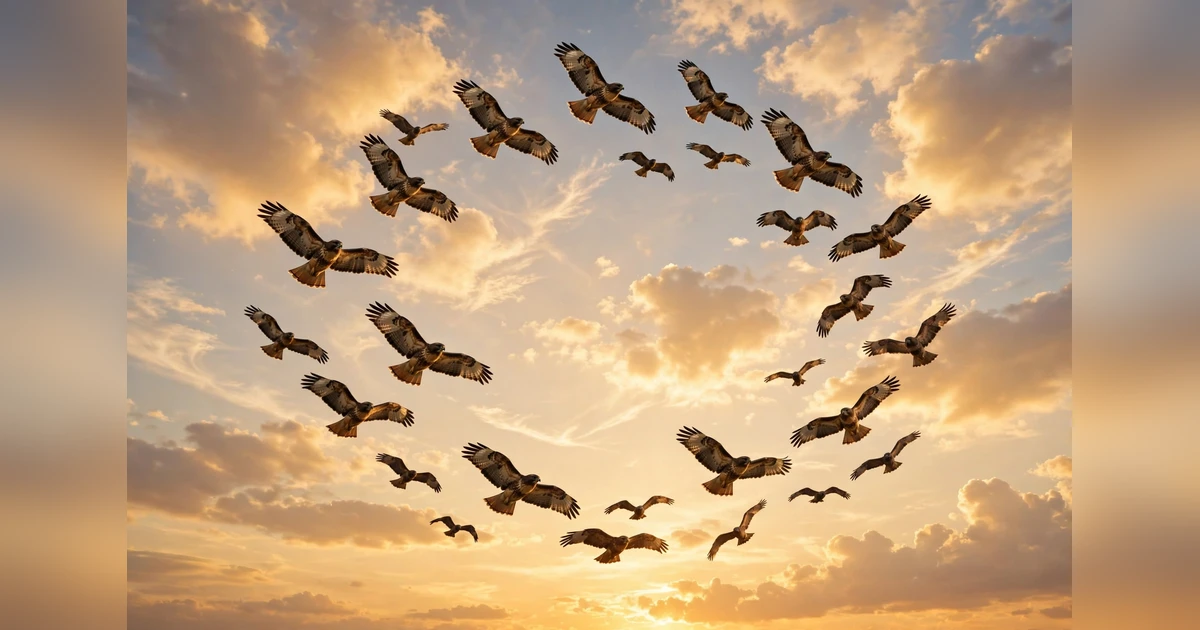
When birds fly in a circle, they are usually riding rising warm air called thermals to gain height without wasting energy. It is one of the most efficient ways to fly, and it is used by hawks, eagles, vultures, gulls, and many other large-winged birds. But the circle also carries a deeper meaning. Across cultures, circling birds have been seen as messengers, as signs of change, and as reminders of the cycles of life.
This guide explains both sides of the story: the science of why birds circle, and the symbolism that people have found in that circling for thousands of years. It also clears up the common misunderstandings, including the old fear that circling birds mean death is near.
The Science: Thermals and the Art of Soaring
Birds flying in circles is not random behaviour. It is rooted deeply in aerodynamics and survival strategy. When the sun warms the ground, the air above it warms too, and that warm air rises in a column called a thermal. A bird that finds a thermal can circle inside it, rising higher and higher, without flapping its wings at all.
This method of flight, called thermal soaring, allows birds to travel long distances while spending almost no energy, a crucial advantage during migration. Rather than flapping continuously, these birds locate pockets of warm, rising air and spiral upward, conserving energy while scanning vast landscapes for food or navigating long migratory routes.
Thermal soaring is most frequently seen in large-winged birds with high wing loading, such as turkey vultures, red-tailed hawks, and golden eagles. Their broad wings are built for gliding, not for constant flapping. A small bird like a sparrow cannot soar in a thermal the same way, because its wings are too small and its body too light to hold a steady circle. The big birds are the masters of the circle.
When a group of hawks or vultures flies in circles on warm air, birdwatchers call it a kettle. A kettle can hold dozens of birds, all circling in the same thermal, all rising together, all silent. It is one of the most beautiful sights in the sky, and it is also one of the most practical: the birds are sharing a free ride upward.
Why Birds Circle: Food, Travel, and Safety
Birds circle for several reasons, and most of them are practical. The first is food. Predators like hawks circle to search for prey from above. From high in the sky, a hawk can see a mouse moving in a field, a rabbit in the grass, or a fish near the surface of the water. Circling lets the hawk scan a wide area without wasting energy, and when it spots prey, it can dive straight down.
The second reason is travel. During migration, birds must cover enormous distances, sometimes thousands of miles. Flapping the whole way would exhaust them. By circling in thermals, they gain height for free, then glide forward until they find the next thermal. It is like climbing a staircase made of air, one circle at a time.
The third reason is safety. Birds that fly in groups, especially starlings, use circling to confuse predators. A murmuration, a huge flock of starlings flying in swooping, swirling patterns, is a defence mechanism. When starlings band together in massive swarms, they can coordinate movements to confuse and avoid predators. Forming an immense flock provides safety through dilution: a predator cannot pick out one bird from thousands.
The fourth reason is communication. Murmurations are also thought to be a visual invitation to attract other starlings to join a group night roost. The swirling patterns say, in effect, “here we are, come and join us.” The circle is a signal, not just a flight pattern.
What Is a Murmuration?
A murmuration refers specifically to a flock of starlings flying in an aerial display. Murmurations consist of hundreds, thousands, upwards of a million starlings flying together in swooping, swirling patterns across the sky. The coordinated movements of the flock are believed to serve as a defence mechanism against predators, but they are also simply beautiful, a living cloud that twists and turns as if it had one mind.
Scientists have studied murmurations for years, and they have found that each starling follows a simple rule: stay close to your neighbours, and match their speed and direction. From those simple rules, the whole flock creates patterns that no single bird could plan. The circle, the wave, the vortex, a circular swirling pattern with a hollow centre around which the birds revolve, all of it comes from thousands of birds making small, local decisions.
Murmurations are most often seen at dusk, when starlings return to their winter roost in a swirl after feeding. The birds gather over the roosting site, sometimes for an hour or more, swirling and swooping before they finally drop down to sleep. It is a daily ritual, and it is one of the great spectacles of the natural world.
The Spiritual Meaning: Circles, Cycles, and Rising Above
Beyond biology, the sight of birds flying in circles has held deep symbolic meaning across cultures throughout history. Birds flying in circles often means they are riding warm air currents called thermals, but many also believe it is a sign of cycles, divine timing, or spiritual alignment.
The circle itself is a powerful symbol. Circles represent wholeness and the cycle of life. A circle has no beginning and no end. It returns to itself, again and again. When birds fly in a circle, they are drawing that symbol in the sky, and people have read it as a reminder that life moves in cycles, that endings become beginnings, and that what goes around comes around.
Some see circling birds as a sign of protection or guidance from above. The birds are high in the sky, looking down on the world, and that elevated view feels like a higher perspective, a reminder to rise above your problems and see the bigger picture. It may suggest you are at a turning point or about to rise to a higher level emotionally or spiritually.
Birds flying in circles can also mean you are in a moment of change or awakening. Pay attention to your thoughts, the old advice says, because you may be circling something important. Like a color that changes with light, a circling flock changes with the sky, dark one moment and bright the next, and that change is a reminder that nothing stays the same for long.
Birds Flying in a Circle in Native American Traditions
In Native American traditions, circular flight, especially by eagles or hawks, is sometimes viewed as a sign of spiritual messages, protection, or divine observation. The circle itself represents unity, continuity, and the cyclical nature of life. The eagle, in particular, is a sacred bird, a messenger between the earthly and spiritual realms, and its circling flight is read as a sign that the spirits are watching, or that a message is on its way.
Some tribes interpret sustained circling as a sign that change is coming, or that one should pay attention to subtle signs in the environment. The eagle does not circle without reason. It circles because it sees something, and if you are watching the eagle, you should ask yourself what it sees that you do not.
In Native American traditions, circling eagles and hawks are seen as messengers, and the circle itself is a reminder of nature‘s cycles. The hawk’s circle is a lesson in patience: the bird does not rush. It rises slowly, it watches carefully, and it strikes only when the moment is right.
Birds Flying in a Circle in Celtic and European Traditions
In Celtic mythology, birds, especially ravens and crows, circling overhead were believed to indicate the presence of spirits or impending transformation. The raven is a bird of mystery, a creature that moves between the world of the living and the world of the dead, and its circling flight was read as a sign that something was about to change.
In parts of rural Europe, farmers once interpreted circling raptors as omens of weather change or harvest outcomes. If hawks circled high and steady, fair weather was likely. If birds flew low and erratically, a storm might be coming. That reading was partly practical: birds do sense changes in air pressure, and their flight changes with the weather. But it was also symbolic: the birds were seen as readers of the sky, and farmers trusted their reading.
Modern spiritual beliefs often reinterpret these symbols more positively. Some people see birds flying in circles as a reminder to rise above life’s challenges or to gain a broader perspective on personal issues. The circle is no longer a warning. It is an invitation to look at your life from above.
Birds Flying in a Circle in African and Middle Eastern Traditions
In some African folklore, vultures circling overhead are believed to signal impending death, not because the birds cause it, but because they are seen as intermediaries between worlds. The vulture can sense a dying animal from great distances, due to its exceptional eyesight and sense of smell, and its circling was read as a sign that a soul was about to cross over.
Similarly, in parts of Africa and the Middle East, vultures circling above were traditionally viewed as harbingers of death, not because they caused it, but because they could sense dying animals from great distances. That belief gave the vulture a sombre reputation, but it also gave it a sacred role: the bird that watches over the boundary between life and death.
It is important to be clear about what the science says. Vultures circle because they are riding thermals, and they use thermals daily regardless of food availability. Their presence does not predict mortality. The circling is normal foraging behaviour, not a premonition. The old belief comes from the fact that vultures do gather where animals have died, but they gather because they can smell or see the carcass, not because they knew it would die.
Common Misunderstandings About Circling Birds
Modern media sometimes misrepresents circular flight as a sign of confusion or distress. Movies and literature may depict birds whirling erratically before disasters, reinforcing misconceptions. In reality, steady, coordinated circling is a sign of health and environmental awareness, not panic.
One common misunderstanding is that birds circle because they are lost or injured. Healthy birds routinely circle in thermals. Erratic flight is more indicative of distress. A bird flying in a smooth, steady circle is a bird that knows exactly what it is doing.
Another misunderstanding is that circling always means migration. Soaring occurs year-round for feeding, territorial patrols, and local movement. Birds circle in summer and winter, on migration and at home. The circle is a tool, and it is used whenever it is useful.
A third misunderstanding is that vultures circle only when death is near. They use thermals daily regardless of food availability, and their presence does not predict mortality. A vulture circling over your house is more likely to be riding a thermal than to be announcing anything about you.
A fourth misunderstanding is about the weather. Birds do not soar best in storms. Birds soar best in stable, sunny conditions. If you see lots of circling birds, fair weather is likely. The thermal needs the sun to form, and without the sun, there is no circle.
What Does It Mean When Birds Circle Your House?
When several birds appear to be circling your house, they may be vultures, in which case either something is dead nearby or they have a roosting tree nearby. That is the practical answer, and it is usually the right one. Vultures roost in tall trees, and they circle above their roost in the morning as the thermals form.
But many people also read a spiritual meaning into circling birds near a home. In some cultures, it is believed that birds circling a house can be a sign of good luck or protection. A flock of birds can symbolize freedom, unity, harmony, and the power of community. In many cultures, birds are seen as messengers, carrying the hopes and dreams of people. They can also represent spirituality, transcendence, and the connection between the earthly and the divine.
If birds are circling your house, the honest answer is to look first for the practical reason: a thermal, a roost, a food source. If there is no practical reason, or if the sight feels meaningful to you, then the spiritual reading is yours to make. The birds do not tell you what to think. They only fly in circles, and the meaning is what you bring to it.
Why Do Seagulls Circle?
When seagulls gather and fly around in a circle, it can mean that they have encountered a swarm of airborne insects, and are closing in to eat them. Seagulls are opportunists, and a swarm of insects is a meal that cannot be missed. The circle lets them stay over the swarm, picking off insects one by one.
Seagulls also circle over fishing boats, over harbours, and over beaches where food is available. Their circling is practical, not mystical. But like all circling birds, they remind us that the circle is a shape of efficiency: the shortest way to stay in one place while moving all the time.
Birds Flying in a Circle Before a Storm
Sometimes when you see birds flying in circles or in a V shape, it is because they sense a storm is coming. This happens because bad weather comes hand in hand with low pressure. Low-pressure systems are areas in the atmosphere where the air pressure is lower than the surrounding areas, and birds can feel that change.
Before a storm, thermals weaken, because the sun is hidden behind clouds. Birds that were soaring will come down, and birds that were flying high will fly lower. The change in their flight is a sign of the changing weather, and people who watch birds have used that sign for centuries to predict rain.
That is not magic. It is observation. The birds are reading the sky, and if you watch them, you can read it too.
How to Watch Circling Birds
If you want to see circling birds for yourself, the best time is a sunny late morning, when the ground has warmed and thermals are forming. Find an open place, a hill, a field, or a rooftop, and look up. Hawks and vultures often circle in the same place for many minutes, rising slowly, and they are easier to spot than you might think: look for a dark shape turning in a wide, steady circle, high in the sky.
Bring binoculars if you have them. With binoculars, you can tell a hawk from a vulture by the shape of its wings and the way it holds them. A vulture holds its wings in a shallow V. A hawk holds them flat. A kettle of birds, dozens circling together, is a sight you will not forget, and it is most common during migration season, in spring and autumn.
Watching circling birds is also a good way to learn patience. The birds do not hurry. They rise slowly, one circle at a time, and they trust the air to carry them. If you stand and watch them for a few minutes, you may find that your own breathing slows down too. That is part of their gift: they remind us that rising does not have to be hard work.
Frequently Asked Questions
Why do birds fly in circles?
Birds fly in circles mainly to ride thermals, columns of warm rising air, to gain height without wasting energy. They also circle to search for food, to travel during migration, to stay safe in a flock, and to communicate with other birds.
What does it mean spiritually when birds fly in a circle?
Spiritually, circling birds often mean cycles, divine timing, protection, or guidance. The circle represents wholeness and the cycle of life. Some see it as a sign of a turning point, or a reminder to rise above a problem and see the bigger picture.
What is a group of birds flying in circles called?
A group of hawks or vultures circling in a thermal is called a kettle. A large flock of starlings flying in swirling, circular patterns is called a murmuration.
Do birds flying in circles mean death is near?
No. There is no scientific evidence for that belief. Vultures circle in thermals daily, regardless of food availability. They gather where animals have died because they can smell or see the carcass, not because they predicted the death.
What does it mean when birds circle your house?
Usually it means there is a thermal, a roosting tree, or a food source nearby. In some cultures, it is also read as a sign of good luck or protection, but the practical explanation comes first.
Why do starlings fly in circles?
Starlings form murmurations, large swirling flocks, mainly for safety in numbers and to attract other starlings to a night roost. The patterns come from each bird following simple rules: stay close to your neighbours and match their speed.
Final Thoughts
Birds flying in a circle are doing two things at once. They are flying efficiently, using the sky’s free energy to rise without effort, and they are drawing a shape that humans have read as meaningful for thousands of years. The science explains the flight. The symbolism explains why we keep watching.
The next time you see birds circling overhead, look at them twice. Once with the eyes of a scientist, and once with the eyes of a storyteller. The scientist will see thermals, wings, and energy. The storyteller will see cycles, messages, and turning points. Both are true, and both are worth seeing.
The circle is the oldest shape in nature, and the birds have been drawing it in the sky long before humans learned to read it. When you see it, you are seeing something ancient, practical, and beautiful, all at once. That is why it stays with you, long after the birds have moved on.