Sand Dollar Symbolism: Meaning, Legend, and Spiritual Significance
The sand dollar symbolizes peace, good luck, abundance, transformation, and spiritual growth. It is a small, flat, white disc that washes up on the beach, and it carries a story that has been told for generations: a story of faith, of five doves hidden inside, of a star and a lily written into its shape, and of a creature that lives hidden beneath the sand yet leaves behind a beautiful relic.
Few discoveries on a beach evoke as much wonder as finding a complete, unbroken sand dollar. These delicate, disc-like skeletons of sea urchins are more than just beachcomber prizes. They are vessels of a profound and beautiful story, and they have become one of the most loved symbols of the sea.
What Is a Sand Dollar?
A sand dollar is not a shell, and it is not a coin. It is the skeleton of a member of the order Clypeasteroida, a type of flattened, burrowing sea urchin. Sand dollars are flattened, burrowing sea urchins belonging to the class Echinoidea, the same class that includes round sea urchins and sea stars.
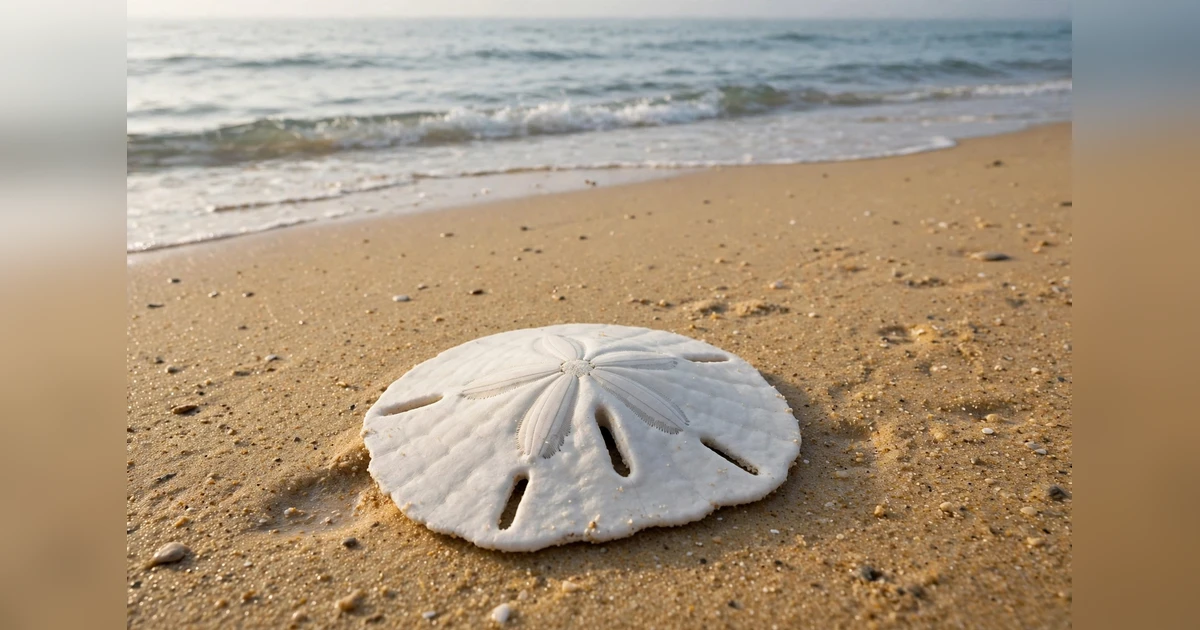
When a sand dollar is alive, it is not white at all. It is covered in tiny spines, and its colour is grey, green, brown, or purple. It lives buried in the sand in shallow coastal waters, eating tiny particles of food from the sand and the water. When it dies, its spines fall away, and what remains is the white skeleton, called a test, that we find on the beach.
The sand dollar grinds its food using a complex structure called Aristotle’s lantern, a unique characteristic shared with other sea urchins. Its mouth is on the underside, and its five rows of tube feet, visible as a flower-like pattern on the top, are used for breathing. The familiar exoskeleton of a sand dollar is white, with a five-pointed shape on the back that looks similar to flower petals. This design mirrors the internal structure of the sand dollar, and it is called petaloid ambulacra. The flower pattern marks the point where specialized gills extend to the surface for gas exchange. It is how they breathe.
Like a color that changes with light, the sand dollar changes with the beach, pale white in the sun and grey-green when it is still alive. The white disc we hold in our hand is the end of a life lived quietly under the sand, and the beginning of a story.
The Legend of the Sand Dollar: A Christian Symbol
The most widely known version of the Legend of a Sand Dollar is deeply rooted in Christian iconography. According to this tradition, the sand dollar carries within its structure a clear and moving representation of the story of Jesus Christ: his birth, death, and resurrection. It is said that Christ left the sand dollar as a symbol to help the evangelists teach the faith.
The entire design, from the star to the flower to the wounds, connects the birth, life, and death of Jesus in one small, intricate package. The legend has been passed down through generations, intertwining Christian symbolism, nautical folklore, and natural history into a narrative that transforms a simple seashell into a spiritual keepsake.
Here is what the legend says each part of the sand dollar means:
The Star of Bethlehem: On the back of the sand dollar, you will see a pattern that distinctly resembles a five-pointed star. This is said to represent the Star of Bethlehem, which guided the Wise Men to the birthplace of Jesus.
The Easter Lily: At the very centre of the star on the underside of the sand dollar, you will notice a pattern that resembles a five-petalled flower, often called an Easter lily. This is a reminder of the resurrection and new life. The lily reminds believers that the story does not end with the crucifixion but with the triumph of the empty tomb.
The Five Wounds: The five holes in a sand dollar, four around the ends of the star and one in the centre, commemorate the five wounds of Christ. According to the religious legend, the four outer holes represent the four wounds of Christ when his hands and feet were nailed to the cross. The centre hole represents the wound made from a soldier’s spear.
The Poinsettia: Around the outer edge of the sand dollar, the marks of the poinsettia, a Christmas flower, are said to evoke the wounds of Christ’s crucifixion: the nails in his hands and feet, and the wound in his side.
The legend is a story, not a scientific fact. But it is a story that has given comfort and meaning to millions of people, and it is why the sand dollar is one of the most cherished symbols of the Christian faith.
The Five Doves: Peace Hidden Inside
One of the most compelling parts of the legend is the discovery of the five doves hidden inside the sand dollar. On the top surface of a sand dollar, you will notice five petal-like slots arranged in a star pattern. These are called lunules or food grooves. The legend says these represent five doves of peace, waiting silently.
When the sand dollar is broken open, five tiny, dove-shaped pieces of calcium carbonate fall out. These are the doves of peace, symbolizing the Holy Spirit and the peace that comes from faith. Because these pieces resemble birds, or more specifically doves, people have often associated both the sand dollar and its doves as a symbol of peace. Some people believe that by breaking open the sand dollar and releasing the doves, they are also releasing peace into the world.
This is not a metaphor but a literal biological feature. The sand dollar, as a living creature, has a complex jaw structure known as Aristotle’s lantern. If you carefully break the sand dollar open, these five pieces fall out, each resembling a dove. When you shake a dried sand dollar, you can hear the rattle of these pieces. The legend says that inside each sand dollar, you will find five doves of peace that spread goodwill and remind us of the gentle presence of the Holy Spirit.
Doves represent peace and love. They release goodwill and peace into the world. The five doves of the sand dollar are therefore a symbol of peace that is hidden inside something small and ordinary, waiting to be found.
The Sand Dollar as Good Luck
While the Christian legend is the most prominent, the sand dollar carries other symbolic meanings that have made it a popular token worldwide. Its shape and structure lend themselves to broader interpretations of luck, mystery, and the cosmos.
Finding a complete, unbroken sand dollar is considered very lucky by many cultures. Because they are so fragile, often shattering into pieces when tossed by waves or stepped on, finding a perfect one is a rare and fortunate event. It is often seen as a sign that good fortune is on its way.
In addition to their religious symbolism, sand dollars represent wealth and abundance. Their delicate, intricately patterned shells are considered lucky finds. Since sand dollar exoskeletons look like large coins, they also symbolize abundance, and finding one is considered a very lucky thing. Some say that they represent coins from the lost city of Atlantis, or even from mermaids under the sea. Often, people give sand dollars as gifts of luck and prosperity.
That gift is a wish: that the person who receives it will have good fortune, abundance, and peace. A sand dollar given as a gift is not just a pretty object. It is a blessing, a small piece of the sea offered with love.
Transformation, Rebirth, and Spiritual Growth
Overall, sand dollars signify transformation, rebirth, prosperity, spiritual growth, and awakening. That meaning comes from the sand dollar’s own life: a living creature that buries itself in the sand, lives quietly, and then leaves behind a beautiful white skeleton. The transformation from a living, spiny creature to a clean, white disc is a symbol of rebirth, of a new form emerging from an old one.
The sand dollar’s fivefold symmetry, reminiscent of a star or a compass, also gives it a meaning of journey and discovery. For travellers and seekers, it can represent guidance, direction, and the journey of life. The grooved petals on top are sometimes seen as markers of a path to follow.
In some New Age and spiritual circles, the sand dollar is seen as a symbol of prosperity, abundance, and the infinite cycles of life and death. Its star pattern represents divine guidance, while the five doves are viewed as messengers from the spirit realm.
The fact that the creature lives beneath the sand, hidden from view, yet leaves a beautiful relic behind has also made it a metaphor for inner beauty and the hidden treasures of the soul. What is most valuable in a person is often hidden, like the sand dollar under the sand, and it is only found by those who look carefully.
Sand Dollar Symbolism in Different Cultures
The sand dollar is not limited to one religious narrative. It is a global symbol of wonder and connection to the sea, and different cultures have given it different meanings.
In the folklore of the Caribbean, the sand dollar is sometimes called a sea cookie, and it is believed to bring safe passage to those who carry it on a voyage. A sailor who carries a sand dollar is protected on the sea, and will return home safely. That meaning comes from the sand dollar’s shape: flat, round, and light, like a biscuit that can be carried in a pocket.
In parts of South America, the sand dollar is considered a symbol of love and fidelity, often exchanged as a token between lovers. A sand dollar given to a lover is a promise: that the love is as enduring as the sea, and as precious as a rare find on the beach.
In coastal cultures around the world, finding a sand dollar on the beach often evokes a sense of wonder and connection to the ocean. It represents a fascinating life cycle of a unique marine creature and, in many cultures, symbolizes peace, hope, and resilience.
Resilience: The Hidden Strength of the Sand Dollar
Even without the religious context, the sand dollar’s resilience and ability to thrive in harsh conditions can serve as a powerful symbol of perseverance and adaptability. The sand dollar lives buried in the sand, in shallow water where waves crash and currents shift. It survives by being flat, by being strong in a quiet way, and by enduring what the sea throws at it.
Finding one on the beach can be a reminder of the beauty and strength found in nature and a call to embrace challenges with grace and fortitude. The sand dollar does not fight the sea. It lives with it, and it leaves behind something beautiful. That is resilience: not the strength to resist, but the strength to endure, and to leave beauty behind.
That meaning is one of the most useful parts of sand dollar symbolism. When life is hard, when the waves are crashing, the sand dollar reminds us that we can survive by being steady, by staying close to the ground, and by trusting that the storm will pass.
What Does It Mean to Find a Sand Dollar?
Finding a sand dollar on the beach is often a moment of wonder. It is a small, white disc, lying on the sand, and it feels like a gift. But what does it mean?
In addition to their religious symbolism, sand dollars represent wealth and abundance. Finding one is considered a very lucky thing, a sign that good fortune is on its way. Overall, they signify transformation, rebirth, prosperity, spiritual growth, and awakening.
The spiritual meaning of finding a sand dollar depends on what you are going through. If you are going through a hard time, finding a sand dollar may be a sign of hope and resilience: a reminder that beauty can survive a storm. If you are starting something new, it may be a sign of transformation and rebirth: a reminder that a new life can emerge from an old one. If you are looking for guidance, its star shape may be a sign that you are on the right path.
The most honest answer is that a sand dollar means what you need it to mean. It is a symbol, and symbols work because they are open: they hold many meanings, and the one that matters is the one that speaks to you.
Sand Dollar in Dreams
Dreaming of a sand dollar is less common than dreaming of other sea symbols, but it carries a clear meaning. A sand dollar in a dream often represents a hidden treasure: something valuable in your life that you have not yet found, or a part of yourself that is still hidden under the sand.
If you dream of finding a sand dollar on a beach, it may mean that good fortune is coming, or that you are about to discover something important about yourself. If you dream of breaking a sand dollar open and finding the five doves, it may mean that peace is coming into your life, or that you need to release something you have been holding inside.
If you dream of a broken sand dollar, it may mean that something fragile in your life needs care, or that a hope has been disappointed. But even a broken sand dollar leaves behind its doves, and the dream may be telling you that peace is still there, even in the pieces.
Sand Dollar in Jewellery and Gifts
The sand dollar is one of the most popular sea symbols in jewellery and gifts. It appears on necklaces, earrings, bracelets, and pendants, and it is given as a gift for many occasions: a birthday, a wedding, a graduation, or a trip to the beach.
As jewellery, a sand dollar usually means good luck and protection. A person who wears a sand dollar is carrying a small piece of the sea with them, and a reminder of peace, abundance, and guidance. It is a quiet symbol, not a loud one, and that is part of its charm.
As a gift, a sand dollar is a wish. It says: I wish you peace, I wish you good fortune, and I wish you a safe journey. It is a gift that costs little and means much, and that is why it has been given for generations.
When you give a sand dollar, you are giving a story. Tell the person about the five doves, the star, and the lily. The gift will mean more, because the story is the gift.
Frequently Asked Questions
What does a sand dollar symbolize?
A sand dollar symbolizes peace, good luck, abundance, transformation, rebirth, prosperity, spiritual growth, and awakening. Its best-known meaning comes from the Christian legend of the five doves, the Star of Bethlehem, and the Easter lily.
What are the five doves inside a sand dollar?
Five dove-shaped pieces emerge every time you open one of these creatures. Doves represent peace and love. They release goodwill and peace into the world. Biologically, they are the sand dollar’s jaw pieces, called Aristotle’s lantern, but the legend gives them a sacred meaning.
What do the symbols on the sand dollar mean?
The four outer holes are said to represent Christ’s four wounds from being nailed to the cross, the fifth represents the wound from a soldier’s spear. The star-shaped pattern in the centre is symbolic of the Star of Bethlehem, an Easter lily, and a poinsettia flower.
What is the spiritual meaning of finding a sand dollar?
Finding a sand dollar is considered very lucky. It signifies transformation, rebirth, prosperity, spiritual growth, and awakening, and it is often seen as a sign of good fortune and divine guidance.
Is it good luck to find a sand dollar?
Yes. Finding a complete, unbroken sand dollar is considered very lucky, because they are so fragile. It is often seen as a sign that good fortune is on its way, and people often give sand dollars as gifts of luck and prosperity.
What is the myth about the sand dollar?
It is said that Christ left the sand dollar as a symbol to help the evangelists teach the faith. The five holes commemorate the five wounds of Christ, while at the centre on one side blooms the Easter Lily, and at the lily’s heart is the Star of Bethlehem.
Final Thoughts
The sand dollar is a small thing with a large story. It is a sea urchin that lives under the sand, a skeleton that washes up white on the beach, and a symbol that carries a legend of birth, death, and rebirth, of five doves and a star, of luck and abundance and peace.
Its meaning is not one thing. It is many things: a Christian symbol, a lucky token, a sign of transformation, a reminder of resilience, and a gift of love. That is why it has lasted for generations, and why people still pick it up on the beach, hold it in their hand, and feel wonder.
The next time you find a sand dollar, hold it gently. Look at the star on its back, and the flower on its underside. Shake it, and listen for the rattle of the five doves. Then put it in your pocket, and carry it with you. It is a small piece of the sea, and a large piece of a story that has been told for a very long time.