Yew Symbolism: What This Ancient Tree Represents
Some trees are admired for their flowers, others for their shade, but the yew is remembered for something unusual: its ability to remain green for centuries. Found in ancient churchyards, historic gardens, and quiet woodlands, the yew tree has witnessed generations come and go. Its twisted branches, dark green needles, and bright red fruits give it a mysterious appearance. Throughout European history, people have connected it with death, immortality, protection, and renewal. Yew symbolism is especially interesting because this tree represents two ideas that seem opposite: the end of life and the possibility of rebirth. Its evergreen leaves suggest continuity, while its long association with burial grounds connects it with remembrance and the passage of time. Modern discoveries about exceptionally old yew trees have made these traditional meanings even more relevant today.
What Does a Yew Tree Symbolize?
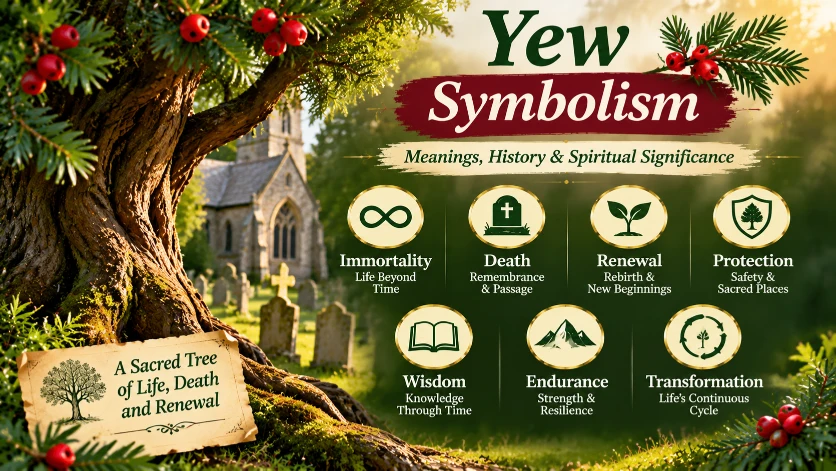
The yew tree commonly symbolizes immortality, death, protection, wisdom, endurance, and renewal. These meanings come mainly from its exceptional lifespan, evergreen appearance, natural regeneration, and historical connections with burial grounds.
Unlike many trees that lose their leaves during winter, the yew remains green throughout the year. This characteristic helped people associate it with life that continues even when everything around it appears to be changing.
Its symbolism also reflects the human relationship with death. Yew trees have stood in European churchyards for centuries, making them familiar companions to places of remembrance.
Here are its most recognized symbolic meanings:
- Immortality: Life continuing beyond physical change.
- Death: The connection between the living and the departed.
- Renewal: The ability to regenerate and begin again.
- Protection: A traditional association with sacred places and burial grounds.
- Wisdom: Knowledge gained through time and experience.
- Endurance: Remaining strong through difficult conditions.
- Remembrance: Honouring ancestors and preserving memories.
These meanings are cultural and historical interpretations, not universal beliefs shared by every society.
Why Is the Yew Tree Connected With Life and Death?
The most unusual part of yew symbolism is its relationship with both life and death.
The European yew (Taxus baccata) is an evergreen tree. It can survive for hundreds or even thousands of years under suitable conditions. Its branches may become twisted, its trunk may develop hollow sections, and parts of its structure may decay while the tree continues producing new growth.
This natural behaviour creates a powerful image of survival.
A very old yew may look as though it has reached the end of its life, yet fresh green needles can continue growing from its branches.
People have used this contrast to understand the relationship between endings and beginnings.
The tree can represent the idea that change does not always mean complete loss. Something may disappear while another form of life continues.
This is one reason yew trees became associated with immortality and resurrection in European folklore. <Cite refs={[“turn127467search0″,”turn127467search6”]}/>
7 Important Meanings of Yew Symbolism
1. Immortality and Eternal Life
Immortality is one of the strongest meanings connected with the yew tree.
Its evergreen foliage remains visible during winter, when many other trees lose their leaves. This creates a natural connection with continuity and life that does not easily disappear.
The tree’s remarkable longevity strengthens this association. Some ancient yews have survived for many centuries, making them living witnesses to historical events and changing communities.
In symbolic interpretations, the yew represents something that continues beyond an individual’s lifetime.
This may include family traditions, memories, cultural heritage, and the influence people leave behind.
Deeper meaning: The yew reminds us that life can leave a lasting influence through memories, relationships, and the things passed to future generations.
2. Death and Remembrance
The yew has a long association with death and remembrance, particularly in Britain and Ireland.
It is commonly found in old churchyards, where some trees are older than the churches standing beside them.
This connection has several possible historical explanations. Yews may have been deliberately planted near burial places because of their symbolic associations with immortality. Their poisonous foliage may also have made churchyards useful locations because grazing animals were kept away.
For many centuries, yew branches were used in funeral customs and other religious traditions.
The tree’s dark evergreen appearance also creates a natural connection with remembrance and reflection.
Deeper meaning: The yew represents respect for the departed and the connection between past and present generations.
3. Renewal and Rebirth
Yew trees have an unusual ability to regenerate.
Some old branches can droop toward the ground, and when conditions are suitable, they may develop roots. This can allow new growth to emerge from an existing structure.
This natural process helped create associations with rebirth and renewal.
The meaning is particularly interesting because the yew can continue growing even when parts of its trunk have become hollow or damaged.
In human life, this can represent recovery after difficult experiences. A person may face disappointment, loss, or major change but still find ways to rebuild.
Deeper meaning: The yew symbolizes the possibility of starting again, even after a difficult ending.
4. Protection and Sacred Places
The yew’s connection with churchyards and ancient sacred sites has given it a protective meaning in European folklore.
People have associated these trees with the boundaries between sacred and ordinary spaces. Their presence near churches and burial grounds helped establish an image of guardianship and spiritual protection.
In some historical interpretations, yews were believed to protect burial places or help purify sacred surroundings.
However, these explanations are not equally supported by historical evidence. The exact reasons for planting yews in churchyards remain uncertain.
Deeper meaning: The yew can represent safety, guardianship, and respect for places that hold spiritual or historical importance.
5. Wisdom and the Passage of Time
A tree that survives for centuries naturally becomes a symbol of time and experience.
Ancient yews have witnessed changes in landscapes, communities, architecture, and human generations.
Their old trunks and complex branches can appear like physical records of everything they have survived.
In literature and symbolic artwork, this makes the yew an image of wisdom, patience, and knowledge gained through experience.
Unlike fast-growing plants, yews develop slowly. Their gradual growth can also remind us that meaningful progress does not always happen quickly.
Deeper meaning: The yew represents patience, experience, and the value of learning from the past.
6. Endurance and Inner Strength
Yews are known for their ability to grow in different environments, including shaded areas and some challenging growing conditions.
Their dense evergreen foliage gives them a strong presence throughout the year.
This has created a connection with endurance and resilience.
The tree can represent people who remain steady during difficult periods without losing their identity or values.
Its ability to continue growing despite damage also provides a useful image of emotional strength.
Deeper meaning: The yew symbolizes staying strong through change and continuing forward when circumstances become difficult.
7. Transformation and the Cycle of Life
The yew connects several ideas that are often treated separately: life, death, remembrance, and renewal.
Its natural growth patterns provide a visual reminder that life is not simply a straight line. Different stages involve change, loss, recovery, and new beginnings.
This makes the yew particularly meaningful in poetry, mythology, and spiritual artwork.
It can represent the acceptance of change rather than fear of it.
Deeper meaning: The yew reminds us that endings and beginnings are connected parts of life’s continuing cycle.
Yew Tree Symbolism in Celtic Mythology and European Folklore
The yew has an important place in European folklore, especially in traditions associated with Britain, Ireland, and the ancient Celtic world.
Its evergreen nature and unusual longevity helped establish its reputation as a special tree.
Some historical interpretations connect it with immortality and the relationship between life and death. Ancient yews were also associated with sacred places and traditional religious practices.
However, it is important not to assume that every ancient Celtic community assigned exactly the same meaning to the tree. Much of what is known comes from later historical interpretation, archaeological evidence, and surviving folklore.
In Irish tradition, old trees could hold special importance as landmarks and places connected with community identity.
The yew also appears in discussions of sacred trees, where its long life and unusual growth made it a powerful natural symbol.
Why Are Yew Trees Found in Churchyards?
If you visit old churchyards in England or Ireland, you may notice large yew trees growing near historic buildings.
This is not simply a decorative choice.
The Woodland Trust notes that at least 500 English churchyards contain yew trees older than the church buildings themselves.
Several explanations have been suggested:
Ancient sacred traditions: Some church sites may have developed near places that already had religious or cultural importance.
Symbolism of eternal life: The evergreen appearance of the yew made it suitable for representing continuity and immortality.
Practical protection: Yew foliage is poisonous to livestock, so planting these trees inside churchyards may have helped keep grazing animals away.
Funeral customs: Yew branches were historically used in certain burial and religious ceremonies.
No single explanation accounts for every churchyard. Different locations may have different histories. <Cite refs={[“turn127467search0″,”turn127467search10”]}/>
The Latest Yew Tree Discovery in 2026: Germany’s Ancient Yew
One of the most interesting recent developments involving yew trees took place in Germany in 2026.
<text weight=”medium” color=”secondary” size=”xs”>LATEST RESEARCH AND CONSERVATION UPDATE · 2026</text>
<text weight=”semibold”>The Steibis Yew: Approximately 1,100 Years Old</text>
A European yew growing near Steibis in the Bavarian Alps was identified as Germany’s oldest known tree following a scientific age assessment.
Researchers estimated its age at approximately 1,100 years, although the possible range is around 900 to 1,300 years.
The tree has a trunk circumference of approximately 5.1 metres and grows on an alpine meadow near the Austrian border.
On June 18, 2026, it was officially recognized as a National Heritage Tree in Germany.
This recognition aims to support the long-term protection and care of exceptional old trees.
The discovery is especially relevant to yew symbolism because it provides a real example of the tree’s extraordinary longevity. A living organism that has survived for more than a millennium makes the traditional association with endurance and continuity easier to understand.
It also highlights the importance of protecting ancient trees as part of natural and cultural heritage. <Cite refs={[“turn286755search3″,”turn286755search2″,”turn286755search8”]}/>
What Does a Yew Tree Look Like?
Understanding the real tree helps explain why it has developed such powerful symbolic meanings.
The European yew is a slow-growing evergreen conifer belonging to the family Taxaceae.
Its main features include:
- Dark green, narrow, needle-like leaves.
- Reddish-brown bark that can become deeply textured with age.
- Flexible branches and dense foliage.
- Red, berry-like structures called arils on female trees.
- A long lifespan, sometimes extending over many centuries.
Unlike many other conifers, yews do not produce typical woody cones. Their seeds are surrounded by fleshy red structures.
The botanical name of the common European yew is Taxus baccata. You can explore its classification and botanical history in the Wikipedia article about <Link url=”https://en.wikipedia.org/wiki/Taxus_baccata” title=”Taxus baccata”/>.
An Important Safety Note
Yew is a highly poisonous plant.
Its leaves, bark, and seeds contain toxic compounds. The fleshy red part surrounding the seed is generally not toxic, but the seed itself is highly poisonous.
Yew can be dangerous to humans, pets, and livestock if eaten. Never treat its red fruits as ordinary edible berries. <Cite refs={[“turn127467search4″,”turn127467search5”]}/>
What Does a Yew Tree Represent in Dreams?
Dreaming about a yew tree can have different personal interpretations depending on the setting and emotions involved.
These meanings are symbolic ideas rather than scientifically established dream predictions.
| Dream situation | Possible symbolic meaning |
|---|---|
| Standing beneath an ancient yew | Wisdom and connection with the past |
| Seeing a green yew in winter | Endurance and hope |
| A yew with a hollow trunk | Memories and the passage of time |
| Planting a young yew | New beginnings and long-term growth |
| Sitting near a yew tree | Reflection and remembrance |
| Seeing a yew in a graveyard | Acceptance, memory, and life’s cycles |
| A fallen yew tree | Change, loss, or the end of a chapter |
For example, someone going through a major life change might interpret an ancient yew as a reminder to remain patient and value their personal history.
The meaning depends more on the dreamer’s own experiences than on a fixed symbolic dictionary.
Yew Symbolism in Literature and Art
Writers and artists have used the yew to create powerful images connected with mortality, time, and memory.
Its presence in a graveyard can establish a serious or reflective atmosphere. Its evergreen foliage may suggest that something continues even after death.
In poetry, an old yew can represent the passage of generations or the contrast between temporary human life and the apparent permanence of nature.
Its twisted branches and hollow trunk also make it visually interesting in paintings and photographs.
A yew growing beside an ancient church can communicate several ideas at once: history, spirituality, remembrance, and endurance.
This is why the tree works so well as a literary symbol. Its real physical characteristics support the deeper meaning rather than relying entirely on imagination.
Frequently Asked Questions About Yew Symbolism
What is the main meaning of yew symbolism?
Yew symbolism is mainly associated with immortality, death, protection, renewal, wisdom, and endurance. These meanings developed through the tree’s evergreen nature, exceptional lifespan, and historical presence in European churchyards.
Why is the yew tree associated with death?
Yew trees are commonly found in European churchyards and burial grounds. Their historical use in funeral customs and their association with remembrance helped connect them with death and mourning.
Does the yew tree symbolize immortality?
Yes. Its evergreen leaves and remarkable lifespan have made it a symbol of immortality and continuity in several European traditions.
What does a yew tree symbolize spiritually?
In spiritual and folkloric interpretations, the yew may represent protection, rebirth, ancestral remembrance, wisdom, and the connection between life and death. Its meaning depends on the cultural tradition.
Why were yew trees planted in churchyards?
Possible explanations include their association with eternal life, earlier sacred traditions, funeral customs, and the practical benefit of keeping poisonous foliage away from grazing livestock.
Is a yew tree a symbol of protection?
In some European folklore, yew trees have been connected with protection and sacred places. Their presence in churchyards helped strengthen this association, although the historical reasons for planting them varied.
What does a yew tree represent in Celtic traditions?
Yew trees are often associated with immortality, death, and renewal in interpretations of Celtic folklore. However, specific meanings should not be assumed to apply equally to every ancient Celtic community.
What is the oldest known yew tree in Germany?
The ancient Steibis yew in the Bavarian Alps was identified in 2026 as Germany’s oldest known tree, with an estimated age of approximately 1,100 years. It became a National Heritage Tree on June 18, 2026.
Final Thoughts
Yew symbolism is unusual because it brings together ideas that seem to oppose one another. The tree represents death because of its long connection with burial grounds, yet its evergreen foliage and remarkable lifespan make it a powerful symbol of immortality. Its ability to continue growing after centuries of environmental change also connects it with resilience and renewal. The 2026 recognition of the ancient Steibis yew adds a modern example to this history, showing that these trees are not simply part of old folklore. They are living reminders of natural endurance, cultural heritage, and the importance of protecting the past for future generations.