Carnation Flower Symbolism: Meaning, Colors, and History
The carnation symbolizes love, fascination, and distinction, and each of its colors carries a different message. It is one of the oldest flowers in the world, loved for more than two thousand years, and it has been a flower of the gods, a flower of mothers, a flower of lovers, and a flower of nations. To understand the carnation, you must understand its colors, because a red carnation and a yellow carnation say two very different things, and giving the wrong one can say the opposite of what you meant.
Carnations are regarded as the Flowers of God, and the association goes back to Dianthus, their scientific name, which is the contribution of Theophrastus, the Greek botanist. In general, carnations symbolize joy, love, pride, and beauty. That is the heart of the carnation’s meaning: that love comes in many forms, and that each form has its own colour.
The Name: Flower of the Gods
Dianthus, the carnation’s scientific name, is derived from two Greek terms, dios, which means god, and anthos, which means flowers. The carnation is, quite literally, the flower of the gods. The Greek botanist Theophrastus called the flower dianthus more than two thousand years ago, and the name has stayed with it ever since.
In ancient Rome, carnations were known as Jove’s Flower, as a tribute to Jupiter, the king of the gods, and they were often used in religious ceremonies. In ancient Greece, carnations were considered flowers for the gods and goddesses, and they were the primary flowers used in ceremonial crowns. To give a carnation was, in the ancient world, to give something divine, something worthy of the gods themselves.
In nature, carnations are Mediterranean flowers, native to the sunny hills of Greece, Italy, and Spain, where they have grown wild for more than two thousand years. Their scientific name is Dianthus caryophyllus, and they are loved for their divine fragrance, their ruffled petals, and their longevity: a carnation can last for weeks in a vase, longer than almost any other cut flower, and that endurance is part of its meaning, that love, like the carnation, can last.
What Does a Carnation Symbolize?
Carnations symbolize love, affection, joy, femininity, and new beginnings. They are a flower of fascination and distinction, which means they are given to someone who stands out, someone who is admired, someone who is loved. A carnation is not a flower you give casually. It is a flower you give when you mean it.
Like a color that changes with light, a carnation changes with its meaning, one color for love and another for goodbye. That is why the carnation is so powerful: because it can say many things, and because each colour says something different, the carnation is a flower that speaks in a language of its own.
The carnation is also a symbol of new beginnings. That is why they are perfect for birthday gifts, and why they are given at graduations, at new jobs, and at the start of a new chapter. A carnation says: this is the beginning of something good.
Pink Carnations: A Mother’s Love
Pink carnations have the most symbolic and historical significance of all the colours. According to Christian legend, carnations first appeared on Earth as Jesus carried the Cross. The Virgin Mary shed tears at Jesus’ plight, and carnations sprang up from where her tears fell. Thus the pink carnation became the symbol of a mother’s undying love.
In 1907, the pink carnation was chosen by Ann Jarvis as the emblem of Mother’s Day, now observed in the United States and Canada on the second Sunday in May. Pink carnations are the symbol of a mother’s love, and they represent the deep and unconditional love that only a mother feels for her children. They also symbolize gratitude, admiration, and affection, and they are often given to someone you have a crush on, since they symbolize the beginning of a romantic relationship. Pink carnations also denote femininity and fertility, and that is why they are a staple in baby-shower and new baby bouquets.
White carnations are also the symbol of motherly love, and they are the number one most popular flower for Mother’s Day in the United States. That is a useful reminder that a mother’s love is not one colour. It is many colours, and it can be pink, or white, or red, and it is still a mother’s love.
Red Carnations: Deep Love and Admiration
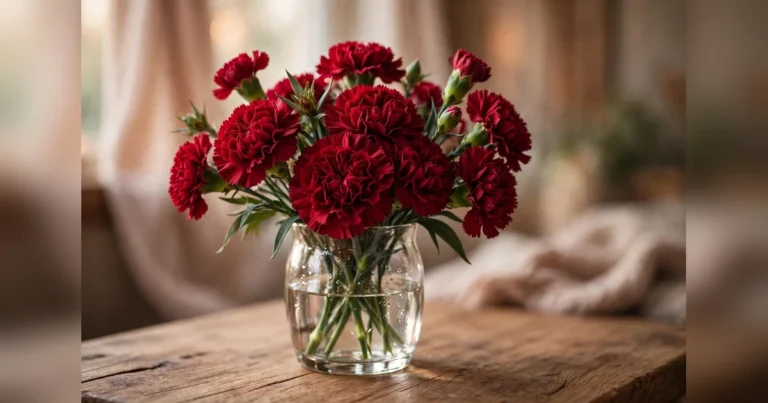
Red carnations are symbolic of affection, courage, passion, love, and admiration. They are the most popular of all the carnation colours, and they are a popular choice for Valentine’s Day and other romantic occasions. Red is the colour of love all around the world, and much like red roses, red carnations denote passionate love and intense feelings towards someone.
There is a difference, though, between light red and dark red. Light red carnations represent admiration, and they are often given to a friend, to say: I admire you, I respect you, I think you are wonderful. Dark red carnations denote deep love and affection, and they are given to a partner, to say: I love you, deeply, truly, and completely.
Red carnations are also the national flower of Spain, where they are associated with the Virgin Mary and used in religious ceremonies and processions. In Spain, a red carnation is not just a flower. It is a symbol of the nation itself, of its faith, its passion, and its pride.
White Carnations: Purity, Luck, and Good Fortune
White carnations represent pure love and good luck. They are often used in weddings and other joyous celebrations, and they symbolize innocence, purity, and eternal love. White carnations also represent youth and eternity, and they are a flower of new beginnings, of fresh starts, and of hope.
There is a lovely tradition at Oxford University, where students wear white carnations during their exams, because they are believed to bring good luck. Gifting a friend a white carnation is the same as sending them good luck and wishing for their success. That is a beautiful use of the flower: not just as a decoration, but as a wish, a hope, and a blessing.
White carnations are also used at funerals, where they symbolize remembrance and a love that does not die. That is the white carnation’s double meaning: it is a flower of joy, and a flower of grief, and it can say both, depending on where it is given.
Yellow Carnations: Disappointment and Rejection
Yellow carnations are the saddest of all the colours. Yellow carnation is a symbol of disappointment and rejection, things that we suffer throughout our lives. Yellow carnation meanings are almost all negative. Unlike its bright and cheerful colour, yellow carnations have quite a sad meaning. They symbolize sadness, rejection, and disappointment.
In the Victorian era, a yellow carnation meant “no.” If a lover sent a yellow carnation, it was a rejection, a refusal, a polite way of saying: I do not love you back. That is why yellow carnations are less commonly given as gifts, and why they should be given with care: because a yellow carnation says something that its bright colour does not suggest.
That said, a yellow carnation can also be a flower of honesty. Sometimes, the kindest thing is to say no, clearly and honestly, and a yellow carnation does that, without words, without argument, and without cruelty. It is a flower that tells the truth, even when the truth is sad.
Purple, Striped, and Green Carnations
Purple carnations symbolize capriciousness or whimsy. They are often given to express a playful or lighthearted sentiment, but they are a flower to be used carefully, because capriciousness means changeability, and a purple carnation can say: I am playful, but I am not serious. That is a message that can be misunderstood, so give a purple carnation only when you are sure it will be taken in the spirit it is meant.
Striped carnations, particularly those with red and white stripes, are associated with a mother’s love and are often given as Mother’s Day gifts. A striped carnation symbolizes a regret that a love cannot be shared, which is a bittersweet meaning: that the love is real, but that circumstances keep it apart. That is a sad meaning, but it is also an honest one, and it is why striped carnations are given when love is real but cannot be fulfilled.
Green carnations are for St. Patrick’s Day, and they are associated with youth, new beginnings, and energy. Green is the symbol of youth, so green carnations stand for new beginnings, youth, and energy. They were famously worn by the Irish writer Oscar Wilde, and green carnations became a symbol of homosexuality, especially after the publication of the scandalous novel The Green Carnation in 1894. That history gives the green carnation a meaning that is both joyful and defiant: a flower that says, I am who I am, and I am not ashamed.
Carnations in History
The origin of the flower goes back to ancient Greece, where it was mentioned two thousand years ago. Carnations trace their roots back over two thousand years. Native to the Mediterranean region, these charming flowers were adored by ancient Greeks and Romans for their divine fragrance and longevity.
In the Victorian era, carnations were used to send secret messages to lovers and suitors. The message depended on the carnation’s colours. For example, a single-coloured carnation meant “yes,” while a yellow one means “no.” That secret language, called floriography, was a way for lovers to communicate when they could not speak openly, and the carnation was one of its most important flowers.
Carnations also appear in art. Leonardo da Vinci painted the Madonna of the Carnation, in which the Virgin Mary holds a carnation, a symbol of her love for her child, and of the divine love that the flower represents. That painting is one of the most famous images of the carnation, and it shows how deeply the flower was woven into the religious imagination of Europe.
The carnation is also a symbol of freedom. In Portugal, the Carnation Revolution of 1974, when the people overthrew a dictatorship without violence, is named for the carnations that soldiers placed in the barrels of their guns. That is a powerful image: a flower, in a gun, as a symbol of peace, and of a revolution that was won without bloodshed. The carnation, in that moment, became a flower of freedom, and it has kept that meaning ever since.
Carnations Around the World
In Spain, red carnations are considered the country’s national flower. In China, carnations are a symbol of luck and prosperity. In France, carnations are symbols of death, and they are given at funerals, not at celebrations. That difference is a reminder that a flower’s meaning is not universal. It depends on the culture, the context, and the history of the place where it is given.
In Korea, a young girl places three carnations in her hair to tell her fortune. If the top flower dies first, her last years of life will be difficult. If it is the middle flower, her earlier years will bring the most grief. Worst of all, if the bottom flower dies first, the poor girl will be miserable her whole life. That is a folk tradition, not a fact, but it shows how seriously carnations were taken: as flowers that could tell the future, as well as express love.
Carnations are the official flower of the first wedding anniversary, making them the perfect choice for a first anniversary celebration. They are also the January birth flower, which means that people born in January can claim the carnation as their own, a flower of love, of distinction, and of new beginnings.
Carnations in Weddings and Anniversaries
Carnations are a wedding flower, and they have been for centuries. White carnations, which symbolize pure love and innocence, are often used in bridal bouquets, in buttonholes, and in table decorations, where their ruffled petals and sweet fragrance add beauty to the celebration. Pink carnations, which symbolize a mother’s love, are often given to the mothers of the bride and groom, as a thank you for their love and their support.
Carnations are also the official flower of the first wedding anniversary. That is a fitting choice, because the first year of marriage is a time of new beginnings, and carnations symbolize new beginnings. A bouquet of carnations on a first anniversary says: this is the beginning of something good, and it is only going to get better. That message is worth more than any gift, because it is a promise, and a carnation, with its long life in a vase, is a promise that lasts.
Carnations are also a good choice for a wedding because they are affordable, because they last, and because they come in almost every colour. A bride can choose white for purity, pink for love, red for passion, or a mix of colours for joy. Whatever she chooses, the carnation will say something meaningful, and it will say it beautifully.
The Carnation in the Language of Flowers
In the Victorian era, flowers had a language, called floriography, and lovers used it to send secret messages to each other. The carnation was one of the most important flowers in that language, because its meaning changed with its colour, and because a single carnation could say what a whole letter could not.
A single-coloured carnation meant “yes.” A yellow carnation meant “no.” A red carnation meant “I love you.” A pink carnation meant “I will never forget you.” A white carnation meant “good luck.” A striped carnation meant “I am sorry, but our love cannot be.” Those messages were simple, but they were powerful, because they were honest, and because they were spoken in a language that only the giver and the receiver understood.
That language is still alive today, in a quieter way. When you give a carnation, you are speaking that language, whether you know it or not. The colour you choose is a message, and the person who receives it will read it, even if they do not know the words. So choose with care, and choose with meaning, because a carnation is never just a flower. It is a sentence, written in petals.
How to Give Carnations
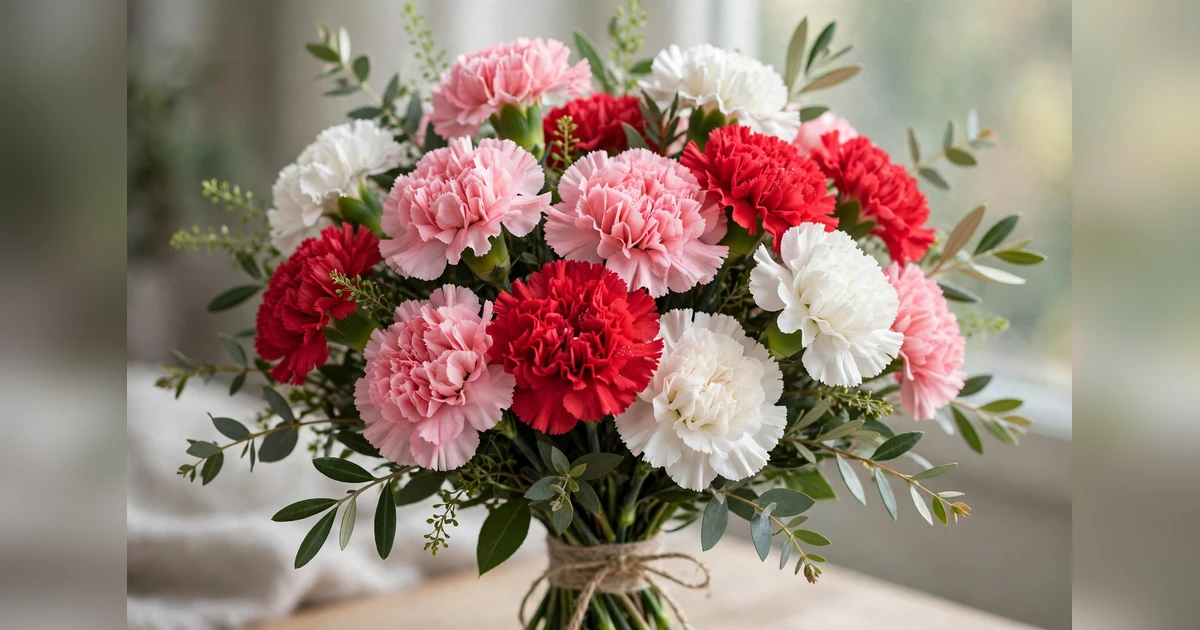
Giving a carnation is an act of communication, and like all communication, it should be done with care. Choose the colour that says what you mean: red for deep love, pink for a mother’s love, white for pure love and good luck, light red for admiration, and never yellow unless you mean to say no.
Consider the occasion: a pink carnation for Mother’s Day, a red carnation for Valentine’s Day, a white carnation for a wedding or a graduation, a carnation of any colour for a birthday, because carnations symbolize new beginnings. And consider the person: a carnation is a flower of fascination and distinction, so give it to someone who stands out, someone you admire, someone you love.
A carnation lasts longer than most flowers, so it is a gift that keeps giving, a reminder of the giver, long after other flowers have faded. That longevity is part of the carnation’s gift: that love, like the carnation, can last, and that a flower given with meaning can be remembered for weeks.
Frequently Asked Questions
What does a carnation symbolize?
Carnations symbolize love, affection, joy, femininity, and new beginnings. In general, they symbolize fascination, love, and distinction, and each colour carries a different meaning.
What does a pink carnation mean?
A pink carnation is a symbol of a mother’s love, and it represents deep and unconditional love. It also symbolizes gratitude, admiration, and affection, and it was chosen by Ann Jarvis in 1907 as the emblem of Mother’s Day.
What does a red carnation mean?
A red carnation represents deep love, affection, and passion. Light red carnations represent admiration, while dark red carnations denote deep love and affection. Red carnations are also the national flower of Spain.
What does a white carnation mean?
A white carnation symbolizes pure love, innocence, and good luck. It is often used in weddings, graduations, and exams, where it is believed to bring good fortune.
What does a yellow carnation mean?
A yellow carnation symbolizes disappointment, rejection, and sadness. In the Victorian era, it meant “no.” It is the saddest of all the carnation colours, and it should be given with care.
Why is the carnation called the flower of the gods?
The carnation’s scientific name is Dianthus, from the Greek dios, meaning god, and anthos, meaning flower. The Greek botanist Theophrastus named it more than two thousand years ago, and in ancient Greece and Rome, carnations were used in religious ceremonies and ceremonial crowns.
What is the carnation’s role in Mother’s Day?
In 1907, Ann Jarvis chose the pink carnation as the emblem of Mother’s Day, because of the legend that pink carnations sprang from the Virgin Mary’s tears. Pink and white carnations are now the traditional flowers of Mother’s Day in the United States and Canada.
Final Thoughts
The carnation is a flower that has been loved for more than two thousand years, and it is easy to see why. It is beautiful, it is fragrant, it lasts longer than almost any other flower, and it speaks a language of its own, in which each colour says something different, and each meaning is worth knowing.
The next time you give a carnation, choose its colour with care. A red carnation says I love you. A pink carnation says thank you, mother. A white carnation says good luck. A yellow carnation says no, and that is a hard thing to say, but it is an honest thing. The carnation is a flower that tells the truth, in colour, in fragrance, and in the long weeks it lasts in a vase. Give it with meaning, and it will be remembered, long after the flower itself has faded.