Spider Web Symbolism: Meaning, Fate, and the Web of Life
A spider web symbolizes the interconnectedness of life, fate, creativity, and patience. It is a net of silk, spun strand by strand, that holds a whole world together: the spider, its food, its home, and its future. Every strand is connected to every other strand, and when one trembles, the whole web feels it. That is the spider web’s deepest meaning: that all things are connected, that every action has a ripple effect, and that we are all, like the spider, weaving our own lives, one thread at a time.
The spider web is a powerful symbol found in cultures worldwide, representing the intricate weave of life, fate, and the interconnectedness of all things. It often embodies creativity and patience, as the spider meticulously crafts its web, but it also carries connotations of entrapment and illusion. That duality, creation and capture, beauty and danger, is what makes the spider web one of the most fascinating symbols in human history.
What Is a Spider Web?
A spiderweb is a net of silk threads spun by a spider to catch insects, often arranged in a round pattern of spokes and spirals. Spiderweb symbolizes patient craft, hidden connection, delicate resilience, and the danger of becoming caught in what you create.
Silk leaves the spider’s body as a liquid protein, hardens in the air, and becomes a structure for living. The spider spends its own body to make its home, strand by strand, and that is a powerful image: creation that costs the creator something, and a home that is literally made of the self.
In nature, a spider web is a net of silk threads spun by a spider to catch insects, often arranged in a round pattern of spokes and spirals. The orb web, the round, symmetrical web of the garden spider, is the most famous shape, and it is also the most symbolic: a circle, a wheel, a sun, and a cosmos, all in one small structure.
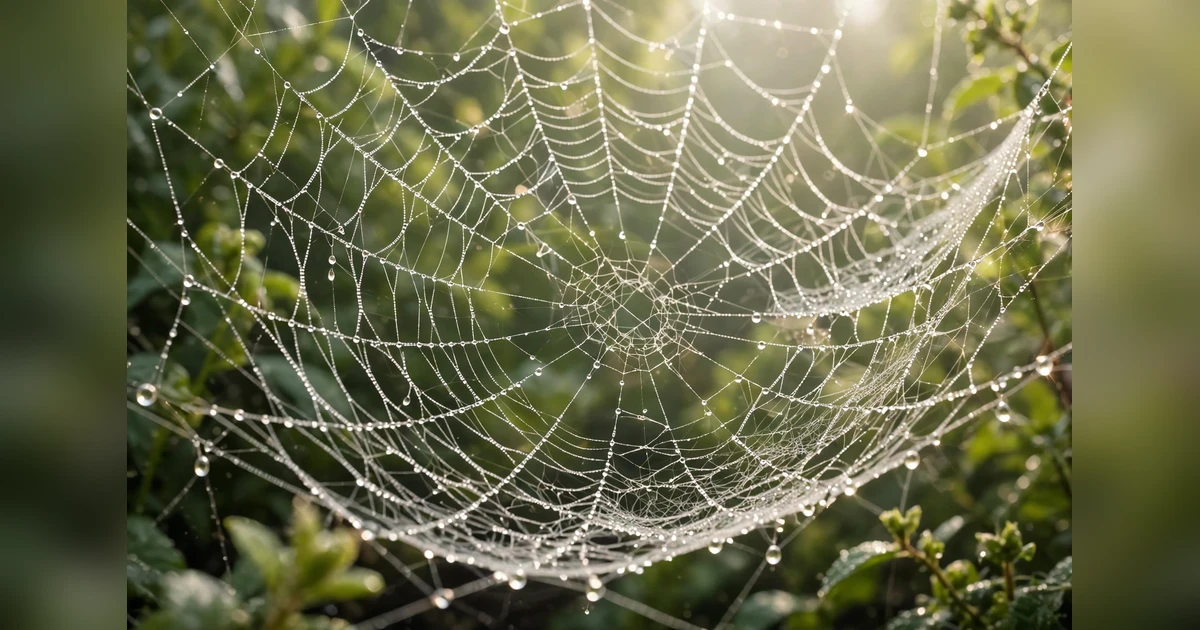
Like a color that changes with light, a spider web changes with the sun, invisible in shade and shining silver in morning light. A web can be almost invisible until light catches it or something becomes caught. This makes it an emblem of systems people overlook because they are quiet: domestic labour, emotional memory, social access, inherited stories, and the work of keeping relationships alive.
The Web of Life: Interconnectedness
A spider web primarily symbolizes the interconnectedness of life. Just as each strand of the web is linked to others, so are events, people, and actions bound together in a larger pattern. The web is a picture of how the world works: nothing is separate, and everything touches everything else.
One strand is slight, almost dismissible; many strands joined at measured angles can hold a body, catch food, and transmit the smallest tremor. That is the web’s lesson: that small things, joined together, become strong. A single thread breaks easily. A web holds.
Spiritually, the spider web is a symbol of the web of life, the idea that all beings are connected and that every action has a ripple effect. When you pull one thread, the whole web moves. When you help one person, the help spreads. When you harm one person, the harm spreads too. The web is a reminder to be careful with your actions, because they do not stay where you put them.
The web also represents the spirit world; in shamanic traditions, the web is a bridge between the physical and spiritual realms. The spider sits at the centre of its web, and from there, it can feel everything that touches it. In the same way, the web is a bridge between what we can see and what we cannot, between the world of the living and the world of the spirit.
Fate and Destiny: The Weavers of Life
The web’s radial structure and the spider’s methodical weaving have been compared to the threads of destiny spun by the Fates in Greek mythology, making it a natural symbol for fate and the interconnectedness of events. The web also represents fate and destiny, as seen in the ancient Greek concept of the Moirai, the Fates, spinning the thread of life.
In many mystical traditions, spiders symbolize destiny, as they are considered weavers of fate. This connection stems from the ancient Greek myth of Arachne, the gifted weaver maiden whose name gave us the term “arachnid.” Arachne was a mortal weaver who challenged the goddess Athena to a weaving contest, and when she won, Athena turned her into a spider, so that she would weave forever. That story links the spider’s web to hubris and punishment, but also to artistic mastery. Arachne’s web is a symbol of a human who dared to challenge a god, and who paid the price, but whose art lived on.
In ancient Egypt, the spider was connected to Neith, the goddess of fate and creation. She was depicted as a warrior and weaver, representing the delicate balance between life and death. The spider web in Egyptian culture symbolized the interconnectedness of all things, showing that even the most minor actions can influence the course of destiny.
Spiders’ intricate spiral webs are seen as symbolic of the cosmos, connected to the Great Mother in that they create, and their web symbolizes the universe. The web is therefore a picture of the cosmos itself: a vast, interconnected structure, woven by a single creator, in which every part is connected to every other part.
Creativity, Patience, and the Art of Weaving
A spider’s web is its home, food source, and even a place to lay eggs. Without a strong, well-built web, a spider cannot survive. That is why the web is a symbol of creativity: the spider creates its world, strand by strand, and its survival depends on the quality of its work.
One of the most powerful lessons spiders teach us is patience. Watching a spider spin its web, one strand at a time, offers a profound reminder of the virtues of persistence and steady effort. A spider does not rush. It builds its web slowly, carefully, and with great attention to detail. And when the web is destroyed, by wind, by rain, or by a careless hand, the spider builds it again, without complaint.
The spider web also teaches us about finding balance as they create symmetrical patterns in their webs, reminding us of the need for harmony and equilibrium. The orb web is a perfect circle, a symbol of balance, and its symmetry is a reminder that a good life, like a good web, needs balance: between work and rest, between giving and receiving, between creation and destruction.
Spiders have long symbolized creativity, resourcefulness, and patience. They are associated with feminine energy and the power of creation. In numerous ancient traditions, spiders were regarded as potent symbols of creation. The Egyptian goddess Neith, who was both a warrior and a creator, is often depicted with a weaving shuttle. That shuttle is the tool of creation, and it is also the tool of fate.
The Spider Grandmother and the Dreamcatcher
In Native American cultures, spiders are often seen as grandmothers, wise protectors who hold sacred knowledge. Their webs are seen as shields against storms, both literal and metaphorical. Native American cultures view spiders as symbols of creativity, wisdom, and the divine feminine.
The most famous Native American spider web symbol is the dreamcatcher. The dreamcatcher comes from the Ojibwe, or Anishinaabe, people, and it is based on the story of Asibikaashi, the Spider Woman, who protected children from bad dreams. The dreamcatcher is a hoop with a web woven inside it, and it is hung above a bed to catch bad dreams in its web, while good dreams pass through the hole in the centre.
The dreamcatcher is a symbol of protection, and it is one of the most widely recognized spider web symbols in the world. It takes the spider web’s meaning, connection, patience, and protection, and turns it into an object that anyone can hang in their home. The dreamcatcher is a reminder that a web can be a shield, not just a trap.
In many traditions, the web is a protective symbol, believed to catch negative energies or harmful spirits before they reach the individual. That is the dreamcatcher’s promise: that the web will catch what is harmful, and let what is good pass through.
Entrapment, Illusion, and the Dark Side of the Web
A spider’s web is also a trap, ensnaring those who unknowingly walk into it. That is the web’s dark side, and it is just as important as its bright side. A web can symbolize entrapment, deception, and illusion. The web is a trap for prey, so it can represent being caught in a difficult situation or a web of lies.
In Hindu and Buddhist tradition, the spider is connected to illusion. Think “web of illusion.” In Buddhism, spiders and their webs represent the illusions of the material world. With its intricate design, the web mirrors how we get caught in the cycle of life, suffering, and rebirth. In Hinduism, the spider’s expansive web aligns with Lord Vishnu’s cosmic web, the great net of Maya, the illusion that keeps us from seeing the truth.
As the web can ensnare, spiders may also represent the devil and the more destructive nature of the Great Mother, because all mothers have a destroyer and creator aspect. The spider is a mother who creates, and a mother who kills. Its web is a home, and a trap. That duality is the spider’s truth: creation and destruction are two sides of the same web.
A dream of being trapped in a spider’s web may symbolize feeling ensnared or caught in an unhealthy pattern that you need to escape from. Nightmares of being trapped in webbing could signify feelings of being caught or ensnared in an unhealthy situation or cycle. The web in a dream is a warning: that you are caught in something, whether it is a relationship, a job, or a habit, and that you need to find your way out.
Manifestation, Prosperity, and Good Fortune
In some spiritual traditions, spiders represent the power of manifestation. Just as a spider spins its web to attract prey, you can use the same concept to attract your desires. The spider does not chase its food. It builds a web, and it waits, and the food comes to it. That is the law of attraction, in its simplest form: build well, and what you need will come.
Many cultures associate spiders with prosperity and abundance. A spider in the house is often seen as a sign of good luck, and a spider climbing up a wall or climbing its web upwards indicates a rise in good fortune. Conversely, a spider running down a wall or descending a thread of silk can mean a downturn in your luck. That belief is old, and it is still held in many parts of the world: that the spider’s direction tells you the direction of your fortune.
The spider climbing down its web symbolizes the descent into the physical realm, representing the journey of the soul from the celestial plane to the material world. That is a reminder that the web connects heaven and earth, and that the spider moves between them, carrying messages from one world to the other.
Walking Through a Spider Web: A Spiritual Sign
Walking through a spider web is a common experience, and in spiritual traditions, it has a meaning. It is often seen as a sign that you are being asked to pay attention, to slow down, and to notice the invisible connections around you. A web you walk through is a web you did not see, and that is its message: that there are things in your life you are not seeing, and that you need to look more carefully.
Some traditions say that walking through a spider web is a sign of good luck, because it means you have touched the web of life, and that the web has touched you. Others say it is a sign that you need to clear away old webs, old patterns, and old habits that are no longer serving you. Both meanings are true: a web you walk through is a reminder that you are part of the web, and that the web is part of you.
Cobwebs, the old, dusty webs in the corners of a house, are a symbol of neglect and decay. A cobweb is a web that has been abandoned, and it is a reminder that even the most beautiful structures fall apart if they are not maintained. But a cobweb is also a reminder that a web can be rebuilt, and that the spider, when it returns, will weave again.
Spider Webs in Dreams
A dream of weaving an intricate web could symbolize your creative powers literally weaving or manifesting your aspirations into reality. If you dream of building a web, it may mean that you are creating something, whether it is a project, a relationship, or a new life, and that your work is going well.
A dream of being trapped in a web means that you feel caught, whether in a relationship, a job, or a pattern of thought. The dream is asking you to find the way out, to cut the threads that hold you, and to free yourself.
A dream of a spider web in the morning light, shining with dew, is a positive sign. It means beauty, connection, and the promise of a new day. The web, in that dream, is not a trap. It is a work of art, and it is a reminder that the world is more beautiful than we think.
Spiders appearing in one’s life, whether crossing your path or showing up repeatedly, can be viewed as reassuring signs that you are in alignment with your intended destiny and higher life purpose. That is the spider’s message: that you are where you are meant to be, and that your web is being woven, strand by strand, towards its purpose.
Spider Webs in Art, Literature, and Everyday Life
The spider web has inspired artists and writers for centuries. In Charlotte’s Web, the children’s novel by E. B. White, a spider named Charlotte weaves words into her web to save her friend Wilbur the pig, and the web becomes a symbol of friendship, of love, and of the power of words. Charlotte’s web is not a trap. It is a message, and it is a reminder that a web can be used to save a life, not just to take one.
In art, the spider web is a symbol of delicacy and of patience. Artists who draw webs know that a web is one of the hardest things to draw, because it is both simple and complex: a few straight lines, and a few spirals, and yet the result is a structure of great beauty. The web is a lesson in art: that simple lines, carefully placed, can create something extraordinary.
In everyday life, the spider web appears in Halloween decorations, where it is a symbol of spookiness and of the unknown. But even there, the web’s meaning is deeper than fear. A Halloween web is a reminder that the world is full of hidden things, of connections we cannot see, and of creatures that work in the dark. The web is a symbol of mystery, and mystery is not always frightening. Sometimes, it is beautiful.
Frequently Asked Questions
What does a spider web symbolize?
A spider web symbolizes the interconnectedness of life, fate, creativity, patience, and protection. It can also symbolize entrapment and illusion, because a web is both a home and a trap.
What is the spiritual meaning of a spider web?
Spiritually, a spider web is a symbol of the web of life, the idea that all beings are connected and that every action has a ripple effect. It is also a bridge between the physical and spiritual realms.
What does the spider web mean in Native American culture?
In Native American traditions, the spider web is associated with the Spider Grandmother, a creator and protector figure. The dreamcatcher, based on the Spider Woman Asibikaashi, uses a web to catch bad dreams and let good dreams pass through.
Who was Arachne?
Arachne was a mortal weaver in Greek mythology who challenged the goddess Athena to a weaving contest. When she won, Athena turned her into a spider, so that she would weave forever. Her story links the spider web to artistic mastery, hubris, and fate.
What does it mean to walk through a spider web?
Walking through a spider web is often seen as a spiritual sign to slow down and pay attention to the invisible connections around you. Some traditions see it as good luck, and others see it as a reminder to clear away old patterns.
What does a spider web mean in a dream?
Weaving a web in a dream means creativity and manifestation. Being trapped in a web means feeling caught in an unhealthy situation. A web shining with dew means beauty and new beginnings.
Is a spider web good luck?
In many cultures, yes. A spider climbing up is a sign of rising fortune, and a spider in the house is often seen as a sign of prosperity. A spider climbing down can mean a downturn in luck.
Final Thoughts
The spider web is one of the oldest and most powerful symbols in the world, and it is still one of the most relevant. It is a picture of how life works: strand by strand, connection by connection, we weave our own webs, and we live in the webs that others have woven.
The web asks us to be patient, like the spider, who builds slowly and rebuilds when the web is broken. It asks us to be creative, like the spider, who makes its world from its own body. It asks us to be careful, like the spider, who knows that every thread is connected to every other thread. And it asks us to be free, like the spider, who knows that a web can be a home, and a trap, and that the difference is in how we use it.
The next time you see a spider web, stop and look at it. Notice its symmetry, its delicacy, and its strength. Notice how the light catches it, and how it shines. And remember: you are part of the web, and the web is part of you. Weave well.