Symbolism in A Raisin in the Sun: Meaning of Important Symbols
Lorraine Hansberry’s A Raisin in the Sun is a famous play about family, dreams, identity, and racial discrimination. It follows the Younger family, an African American family living in a small apartment in Chicago. Each family member wants a better future, but their dreams are not always the same. Through everyday objects and important moments, Hansberry gives deeper meaning to their struggles. Symbolism in A Raisin in the Sun helps readers understand these hidden messages. Mama’s little plant, the family house, the insurance money, Beneatha’s hair, and even a simple plate of eggs represent much bigger ideas. These symbols show how hope, pride, love, and freedom can survive even when life becomes difficult.
What Does Symbolism Mean in A Raisin in the Sun?
Symbolism is when an object, action, place, or character represents a deeper idea. Writers use symbols to help readers understand feelings and messages without explaining everything directly.
In A Raisin in the Sun, Hansberry uses ordinary things from the Younger family’s daily life to represent their biggest hopes and problems.
For example, Mama’s small plant represents her dream of giving her family a better home. The insurance check represents opportunity, but it also creates conflict because every family member has a different plan for the money.
These symbols connect the family’s personal struggles with larger issues such as the American Dream, racial inequality, financial hardship, and cultural identity.
7 Important Symbols in A Raisin in the Sun
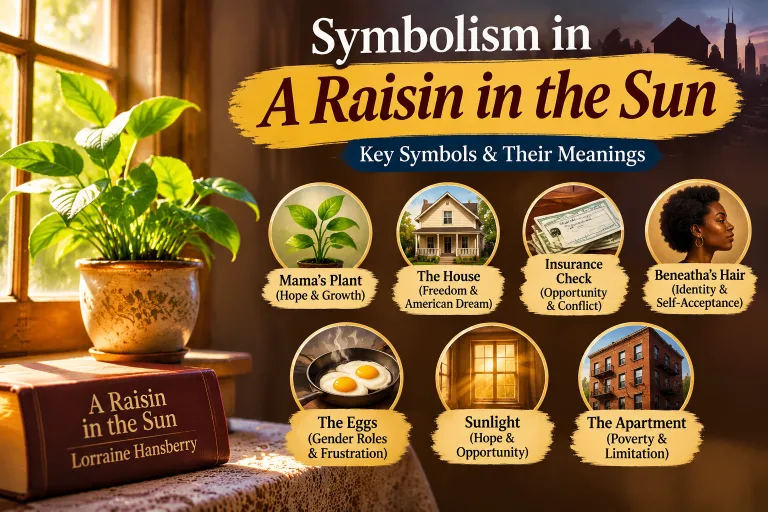
1. Mama’s Plant: Hope and Family Growth
MAIN SYMBOL OF THE PLAY
Mama’s little plant is one of the most important symbols in the entire play. It represents hope, care, patience, and her dream of building a better life for her family.
The plant does not receive enough sunlight or water in the small apartment. However, Mama continues to look after it. She waters it and places it near the window so it can receive whatever sunlight is available.
This reflects her own life. Mama has faced many difficulties, but she has never stopped caring for her children. Like the plant, her family is trying to grow despite living in difficult conditions.
The plant also represents Mama’s dream of owning a house with a garden. She wants a place where her family can enjoy fresh air, sunlight, and more space.
Deeper meaning: The plant shows that hope can survive even in poor conditions. With love and care, people can continue to grow and work toward a better future.
2. The House: Freedom and the American Dream
The house in Clybourne Park represents a fresh start, independence, and the American Dream.
Mama wants to buy a house because she believes her family deserves a comfortable place to live. Their current apartment is crowded, old, and unsuitable for a growing family.
The new house offers something they have never truly enjoyed: enough space, a private yard, and the chance to build a better future.
However, the house also represents racial inequality. Clybourne Park is a white neighborhood, and some residents do not want a Black family moving into their community.
This shows that achieving the American Dream is not equally easy for everyone. Even when the Youngers have enough money to buy a house, racial discrimination creates another obstacle.
Deeper meaning: The house represents freedom, dignity, equal opportunity, and the right to choose where a family wants to live.
3. The Insurance Check: Opportunity and Conflict
The insurance check represents both hope and conflict in the Younger household.
The money comes from the life insurance policy of Mama’s late husband, Walter Sr. Each family member sees it as an opportunity to change their future.
Walter Lee wants to invest in a liquor store because he believes business ownership will bring financial success and independence.
Mama wants to use the money to buy a family home. Beneatha hopes to receive financial support for her medical education, while Ruth also wants a better living environment for her family.
Although everyone wants a better life, they disagree about how to achieve it.
The check becomes more than money. It tests the family’s trust, responsibility, and understanding of one another.
Deeper meaning: The insurance money represents opportunity, but it also shows how financial pressure can create conflict between people who love each other.
4. Beneatha’s Hair: African Identity and Self-Acceptance
Beneatha’s hair represents cultural identity, independence, and self-acceptance.
At the beginning of the play, she wears her hair straightened. After conversations with Joseph Asagai, a Nigerian student, she begins thinking more deeply about her African heritage.
She eventually cuts her hair and wears it naturally.
This change is important because it shows her desire to understand and accept her cultural roots instead of changing her appearance to fit society’s expectations.
Her hair becomes a symbol of Black pride and resistance to cultural pressure.
It also connects with her personal journey. Beneatha wants to become a doctor and make her own decisions about her future. She does not want other people to decide who she should be.
Deeper meaning: Beneatha’s natural hair represents pride in African heritage, personal freedom, and the confidence to accept one’s identity.
5. The Eggs: Gender Roles and Frustration
Eggs may seem like an ordinary breakfast item, but they carry an important meaning in the play.
Early in the story, Ruth repeatedly tells Walter to eat his eggs instead of continuing to argue about his dreams.
Walter becomes frustrated because he feels that Ruth does not understand his ambitions. He believes that people around him are constantly telling him to accept his situation instead of encouraging him to achieve something greater.
The eggs become connected with the traditional roles of men and women in the household. Ruth is preparing breakfast and managing everyday responsibilities, while Walter wants to become financially successful and respected.
This difference creates tension between them.
However, the eggs also show how everyday family duties can become part of larger disagreements about ambition, responsibility, and gender expectations.
Deeper meaning: The eggs symbolize frustration, domestic responsibilities, and the struggle between accepting reality and pursuing personal dreams.
6. Sunlight and the Window: Limited Opportunities and Hope
Sunlight and the apartment window are closely connected to Mama’s plant.
The small apartment does not provide the plant with enough sunlight. Mama tries to give it the best possible place near the window, but its growing conditions remain limited.
This situation reflects the Younger family’s life. They have dreams and abilities, but poverty and racial discrimination prevent them from enjoying the opportunities they deserve.
The sunlight represents hope and the possibility of growth. The window represents the limited access the family has to a better environment.
When Mama finally buys the house, the family gets a chance to move beyond these limitations.
Deeper meaning: Sunlight represents hope, opportunity, and a better future, while the limited light in the apartment reflects the restrictions placed on the family’s lives.
7. The Apartment: Poverty and Unfulfilled Dreams
The Younger family’s apartment represents financial hardship, limited opportunities, and years of struggle.
The apartment is crowded and worn down. Several family members share a small living space, and the furniture shows signs of long use.
It is not simply an uncomfortable home. It reflects the economic and social conditions that have limited the family’s choices.
The apartment also represents dreams that have been delayed for many years. Walter wants financial independence, Beneatha wants an education, and Mama wants a proper home for her family.
Their living conditions make these goals harder to achieve.
However, the apartment also holds family memories. It is where they have supported one another, argued, celebrated, and faced difficult situations together.
Deeper meaning: The apartment symbolizes poverty and restricted opportunities, but it also represents family history, endurance, and shared experiences.
The Meaning of the Title: A Raisin in the Sun
The title A Raisin in the Sun comes from Langston Hughes’s poem Harlem, which asks what happens when a person’s dream is delayed for too long.
The poem compares an unfulfilled dream to something that may dry up or change over time. This idea connects directly with the Younger family.
Each character has a dream:
- Walter Lee wants financial success and respect.
- Mama wants a comfortable home for her family.
- Beneatha wants to become a doctor and discover her identity.
- Ruth wants a peaceful home and a secure future for her son.
Their dreams have been delayed by poverty, discrimination, and family responsibilities.
The title asks an important question: What happens when people cannot achieve the things they hope for?
For the Youngers, delayed dreams create frustration, arguments, and sadness. However, they also continue to fight for a better future.
Deeper meaning: The title represents delayed dreams, lost opportunities, and the emotional pain caused by a society that makes success difficult for some people.
Other Important Symbolic Ideas in the Play
Mr. Lindner’s Offer: The Price of Dignity
Karl Lindner represents the racial prejudice that the Younger family faces when they try to move into Clybourne Park.
He offers the family money to stay out of the neighborhood. His offer may sound polite, but its real purpose is to stop a Black family from moving into a predominantly white community.
The money represents an attempt to buy the family’s silence and cooperation.
Walter eventually refuses the offer, showing that his family’s dignity is more valuable than financial gain.
Deeper meaning: Lindner’s offer represents racism, social exclusion, and the pressure to give up personal dignity for money.
The Moving Boxes: Change and a New Beginning
The moving boxes near the end of the play represent change and the beginning of a new chapter.
The Younger family is finally preparing to leave their old apartment and move into the house Mama purchased.
Their decision is important because they are not simply changing their address. They are taking a step toward independence and a better future.
The boxes also show that change requires courage. The family knows that life in the new neighborhood may not be easy, but they choose to move forward.
Deeper meaning: The moving boxes represent progress, courage, and the willingness to face an uncertain future.
How Does Symbolism Support the Main Themes?
The symbols in the play work together to communicate Hansberry’s larger message.
| Symbol | Main idea | Connection to the play |
|---|---|---|
| Mama’s plant | Hope | The family continues to grow despite hardship |
| The house | Freedom | The family seeks a better life |
| Insurance check | Opportunity | Different dreams create conflict |
| Beneatha’s hair | Identity | She accepts her African heritage |
| Eggs | Gender roles | Walter struggles with family expectations |
| Sunlight | Hope | People need opportunities to grow |
| Apartment | Poverty | The family faces limited choices |
| Lindner’s offer | Racism | Society tries to restrict their freedom |
| Moving boxes | New beginnings | The family chooses progress |
Together, these symbols show that the play is about much more than money or buying a house. It explores the human need for respect, identity, opportunity, and a place to belong.
Frequently Asked Questions About Symbolism in A Raisin in the Sun
What is the most important symbol in A Raisin in the Sun?
Mama’s plant is one of the most important symbols in the play. It represents her hope, love, patience, and desire to provide a better future for her family. Its ability to grow in difficult conditions reflects the Youngers’ determination.
What does Mama’s plant symbolize?
Mama’s plant symbolizes hope, family care, and the dream of owning a home with a garden. Just as she looks after the plant, she works hard to protect and support her children.
What does the house symbolize in A Raisin in the Sun?
The house symbolizes freedom, independence, security, and the American Dream. It also represents the Younger family’s struggle against racial discrimination in housing.
What does Beneatha’s hair symbolize?
Beneatha’s natural hair symbolizes African heritage, Black pride, cultural identity, and self-acceptance. Her hairstyle change reflects her decision to embrace her roots.
What does the insurance money symbolize?
The insurance money represents opportunity and the possibility of a better future. However, it also creates conflict because each family member has a different dream for how the money should be used.
What does the title A Raisin in the Sun mean?
The title refers to Langston Hughes’s poem Harlem. It represents dreams that are delayed or prevented from becoming reality. The title highlights the frustration and emotional struggles experienced by the Younger family.
How does symbolism connect to the American Dream?
The symbols show that the American Dream means different things to different people. For Mama, it is owning a family home. For Walter, it is financial independence. For Beneatha, it is education and personal freedom. Their struggles reveal the barriers that prevent equal access to these opportunities.
Final Thoughts
Symbolism in A Raisin in the Sun helps readers understand the deeper meaning behind the Younger family’s struggles. Mama’s plant represents hope, the house represents freedom, and Beneatha’s hair represents cultural identity. Other symbols, such as the insurance check, eggs, and sunlight, reveal the family’s dreams and challenges. Through these everyday objects, Lorraine Hansberry shows how poverty, racial discrimination, and social expectations affect people’s lives. Most importantly, the play teaches that money is not the only measure of success. Family, dignity, identity, and the courage to follow your dreams are equally important.