Family Symbolism: What Objects, Traditions, and Images Say About Family
A family photograph kept beside a bed, an old dining table surrounded by relatives, or a tree with branches reaching in different directions can all carry a meaning beyond what we see. These images and objects often remind us of the people who raised us, the memories we share, and the connections that shape our lives. This is the idea behind family symbolism. It explores how ordinary objects, natural elements, traditions, and meaningful images represent love, belonging, ancestry, protection, and togetherness. A family does not have to look the same in every home, and its symbols do not have to follow one tradition. For some people, a tree represents several generations. For others, a simple family meal carries the strongest meaning. Understanding these symbols helps explain how people express their connections and preserve family stories across generations.
What Does Family Symbolism Mean?
Family symbolism refers to the use of images, objects, traditions, and actions to represent family relationships and shared values.
These symbols can communicate ideas that are sometimes difficult to explain directly. A photograph may represent a memory, a family home may represent security, and an inherited necklace may connect someone with relatives who lived long before them.
Family symbolism can appear in many forms:
- Natural symbols: Trees, roots, branches, flowers, and birds.
- Personal objects: Family photographs, jewellery, letters, and heirlooms.
- Shared spaces: Homes, gardens, kitchens, and dining tables.
- Visual designs: Hearts, circles, knots, and family crests.
- Traditions: Weddings, celebrations, family meals, and annual gatherings.
The meaning of a symbol usually comes from the experiences and values people attach to it. The same object may have a completely different meaning in another household.
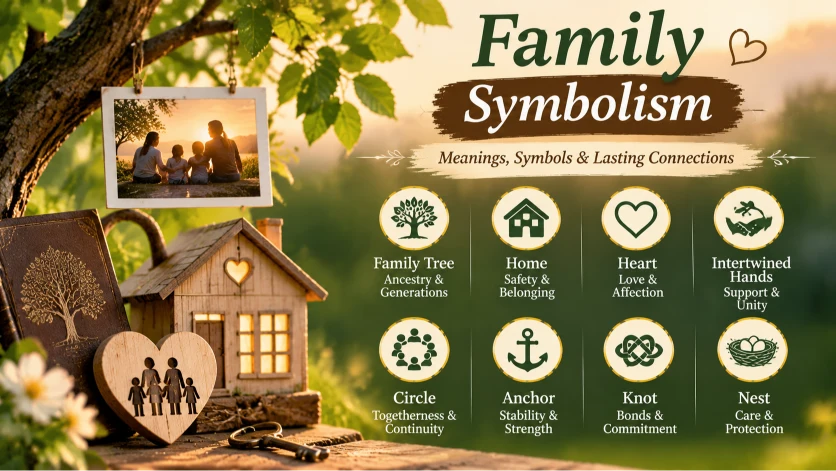
8 Meaningful Symbols That Represent Family
Some symbols appear repeatedly in family artwork, jewellery, literature, and cultural traditions. Each one communicates a different part of what family means.
1. The Family Tree: Generations and Ancestral Connections
The family tree is one of the best-known representations of family relationships.
Its structure provides a natural way to explain how people are connected. The trunk represents a shared beginning, while the branches represent children, grandchildren, and future generations. The roots can represent ancestors and the history that supports the family.
This symbol is especially useful because it shows that family relationships extend beyond the people living in one household.
For example, a family tree may include grandparents, parents, children, cousins, and distant relatives. Each branch adds another part to the family’s history.
The tree also represents growth. Every generation adds new experiences, traditions, and stories while remaining connected to earlier generations.
What it represents: Ancestry, family history, generational growth, and belonging.
2. The Family Home: Safety and Belonging
A home is more than a building. It can represent the place where people feel accepted, protected, and connected.
The smell of a familiar meal, a favourite chair, or the sound of relatives talking in another room can create strong emotional memories.
This is why homes often appear in paintings, stories, and family-themed artwork as symbols of security and belonging.
A childhood home may remain meaningful even after someone moves to another city or country. It holds memories of celebrations, difficult moments, and everyday experiences.
The idea of home can also exist without a permanent building. People may feel at home wherever their closest family members are.
What it represents: Protection, comfort, stability, memories, and emotional security.
3. The Heart: Love and Emotional Connection
The heart is a widely recognized symbol of love and affection.
In family symbolism, it represents the emotional relationships between parents, children, siblings, grandparents, and other loved ones.
A heart-shaped pendant, handmade card, or family tattoo can communicate affection without requiring a long explanation.
It is also used in family illustrations to show that relationships are built through care, kindness, and emotional support.
However, family love is not always expressed through dramatic gestures. It can appear in everyday actions, such as checking whether someone has arrived safely or remembering an important date.
What it represents: Love, affection, compassion, loyalty, and emotional connection.
4. Intertwined Hands: Support and Cooperation
Hands holding one another are a powerful visual representation of family support.
They can show the relationship between a parent and child, the closeness of siblings, or the support shared between generations.
Intertwined hands also communicate cooperation. Family members may have different personalities and opinions, but they can still work together when someone needs help.
This symbol is particularly meaningful during difficult periods, such as illness, financial hardship, or major life changes.
It reminds us that family relationships are strengthened through actions, not simply through shared names or ancestry.
What it represents: Trust, support, protection, cooperation, and unity.
5. The Circle: Togetherness and Continuity
A circle has no visible beginning or end. Because of this, it is often used to represent continuity, connection, and lasting relationships.
In family-themed designs, people standing or holding hands in a circle can represent unity and mutual support.
The shape can also represent the connection between generations. Parents raise children, children eventually become adults, and new family relationships develop over time.
However, a healthy family does not require everyone to agree about everything. The circle can also represent the ability to remain connected while respecting individual differences.
What it represents: Unity, continuity, inclusion, and lasting connections.
6. The Anchor: Stability During Difficult Times
An anchor is designed to keep a boat from drifting away. In symbolic artwork, it often represents stability and security.
When used to represent family, the anchor can symbolize the people who help someone remain grounded during uncertain periods.
For example, someone moving abroad may feel nervous about leaving familiar surroundings. Regular calls with parents or siblings can provide a sense of emotional stability.
The anchor is also popular in family jewellery and tattoos because it communicates loyalty and dependable relationships.
What it represents: Stability, reliability, protection, and emotional strength.
7. The Knot: Bonds That Hold People Together
A knot can represent the strength of relationships and the connections that hold people together.
Unlike a simple line, a knot involves strands crossing and joining. This makes it a useful visual metaphor for families whose members have different personalities, backgrounds, and experiences.
The symbol can also represent commitment and promises between people.
Some family-themed designs use Celtic knot patterns because their continuous lines create an appearance of interconnectedness. Specific meanings depend on the design and its historical context.
What it represents: Connection, commitment, loyalty, and enduring relationships.
8. The Nest: Care and Protection
A bird’s nest is a natural symbol of shelter, nurturing, and protection.
Parent birds build nests to provide a place where their young can develop before becoming more independent.
This makes the nest a meaningful symbol for family life, particularly the relationship between parents and children.
A nest does not keep young birds in one place forever. Its purpose is to provide protection while they grow strong enough to explore the world.
In family artwork, this can represent the balance between caring for loved ones and allowing them to become independent.
What it represents: Parenthood, care, protection, growth, and a safe beginning.
Everyday Objects That Carry Family Meaning
Not every family symbol needs to be an ancient design or a traditional image. Some of the strongest symbols come from objects people use every day.
Consider these examples:
| Object | What it can represent |
|---|---|
| Old family photograph | Shared memories and identity |
| Wedding ring | Commitment and partnership |
| Grandparent’s watch | Family history and remembrance |
| Handwritten recipe | Cultural heritage and tradition |
| Dining table | Togetherness and communication |
| Family quilt | Care, creativity, and shared history |
| Childhood toy | Memories and early experiences |
| Inherited jewellery | Connection between generations |
An ordinary object can become deeply meaningful because of the story behind it.
For example, a wooden spoon may not seem valuable to anyone outside the family. But if it belonged to a grandparent who prepared meals for everyone, it may become one of the household’s most treasured possessions.
The emotional value comes from the memory, not the object’s price.
How Family Traditions Become Symbols
Family symbolism is not limited to physical objects. Repeated activities can also become meaningful symbols of identity and belonging.
A Sunday lunch, an annual holiday visit, or a birthday celebration may look like an ordinary activity to outsiders. Within the family, however, it can represent continuity and shared history.
Family rituals are especially interesting because their meaning often develops over time.
For example, a family may prepare the same meal every year during a holiday. Children grow up associating that recipe with grandparents, relatives, and childhood memories.
Research published in the Journal of Family Theory & Review explains that family rituals carry shared symbolic meanings and help communicate a family’s identity across generations.
Here are some common examples:
- Family dinners: Communication, togetherness, and shared responsibility.
- Birthday traditions: Recognition, affection, and celebration.
- Wedding ceremonies: Commitment and the joining of families.
- Holiday gatherings: Cultural identity and continuity.
- Remembering ancestors: Respect, remembrance, and family history.
- Passing down recipes: Preserving knowledge and cultural traditions.
A routine becomes especially meaningful when family members attach memories and shared values to it.
Family Symbolism Across Different Cultures
Family is important in many societies, but people express family connections in different ways.
Chinese Family Traditions
In many Chinese family traditions, respect for elders, ancestral remembrance, and generational relationships have important roles.
Family gatherings during Lunar New Year provide opportunities for relatives to reconnect, share meals, and maintain relationships.
Ancestral tablets, family records, and traditional photographs may also help preserve connections with earlier generations.
Indian Family Traditions
In many Indian communities, family relationships extend beyond parents and children to include grandparents, uncles, aunts, cousins, and other relatives.
Shared meals, wedding ceremonies, religious celebrations, and family gatherings can represent unity and mutual responsibility.
The exact customs differ between regions, religions, and individual households.
Japanese Family Traditions
Family remembrance and respect for ancestors are important in several Japanese traditions.
During Obon, many families honour deceased relatives through visits, ceremonies, and other remembrance practices.
Family photographs and household memorial spaces can also help maintain a connection with previous generations.
Western Family Traditions
In many Western societies, family trees, wedding rings, photographs, and inherited possessions are common ways of expressing family identity.
Family gatherings during Christmas, Thanksgiving, birthdays, and anniversaries can also represent shared memories and belonging.
These examples are not universal descriptions of entire countries. Family traditions differ between households, communities, and generations.
How Family Symbolism Has Changed in Modern Life
The meaning of family has become more visible in modern discussions about identity and relationships.
Families today may include biological relatives, adoptive parents, stepfamilies, single parents, grandparents raising children, and chosen family members.
As a result, traditional symbols are sometimes adapted to represent a wider understanding of belonging.
For example, a family tree may include adoptive relationships rather than showing only biological connections. A group of hands may represent close friends who provide the support usually associated with relatives.
Photographs, digital albums, and video calls have also changed how families preserve memories across different countries.
The important idea is that family symbolism does not have to follow one fixed structure. A meaningful family symbol should reflect the actual relationships and experiences of the people it represents.
Frequently Asked Questions About Family Symbolism
What is the most common symbol of family?
The family tree is one of the most recognizable symbols of family. It represents ancestry, generations, shared history, and the connections between relatives.
What flower symbolizes family?
Several flowers can represent family depending on cultural and personal interpretations. Forget-me-nots are often associated with remembrance and lasting connections, while carnations are commonly connected with affection and family love.
What animal symbolizes family?
Elephants, wolves, penguins, and swans are sometimes used to represent family relationships because of their social or parental behaviours. Their meanings in artwork are symbolic interpretations and should not be treated as universal facts about every species.
What shape represents family unity?
The circle is commonly used to represent family unity because it has no obvious beginning or end. It can symbolize continuity, inclusion, and lasting connections.
What does a family tree symbolize?
A family tree represents ancestry, generational relationships, heritage, and the growth of a family over time. Its roots often represent ancestors, while its branches show descendants.
What does a family home symbolize?
A family home can symbolize security, belonging, comfort, and shared memories. It represents the place where people feel connected and accepted.
Can a tattoo represent family?
Yes. Family tattoos often use trees, hearts, names, dates, birds, infinity signs, or meaningful phrases to represent relationships, remembrance, and commitment.
What is a symbol for a strong family?
Intertwined hands, anchors, trees with deep roots, and connected knots are commonly used to represent strength and support within a family.
Final Thoughts
Family symbolism is found in more places than traditional artwork or decorative designs. It lives in the objects people preserve, the meals they share, the stories they tell, and the traditions they continue. A family tree can explain where people come from, while an old photograph can bring back memories that might otherwise be forgotten. A home can represent safety, and a simple handwritten recipe can connect several generations. Ultimately, family symbols are meaningful because of the relationships and experiences behind them. Their value comes from what people share, remember, and choose to carry forward.