White Bird Symbolism: Meaning, Spiritual Messages, and Cultural Wisdom
A white bird symbolizes peace, purity, spiritual messages, and hope. When a white bird crosses your path, whether it is a dove, a swan, an egret, or a heron, people across cultures have read it the same way for thousands of years: as a messenger between worlds, a sign of a clean heart, and a reminder that something greater is watching over you. White birds have captured human attention for centuries. Their bright feathers, gentle flight, and quiet presence often feel almost otherworldly. In many traditions, they appear as messengers, symbols of peace, or signs of something deeper.
White birds are not a single species. They are many different birds that share one colour, and that colour is what gives them their meaning. White is the colour of purity and innocence, of light and spiritual clarity, and when it appears on a bird, a creature that already flies between earth and sky, the meaning becomes even stronger. A white bird is a bridge: between heaven and earth, between the living and the dead, between what you are and what you hope to become.
Why White Feathers Matter: The Biology Behind the Symbol
Most white birds, like snowy egrets, great egrets, or swans, are not pigment-free. They lack melanin in their feathers due to genetic regulation, not because they cannot produce pigment at all. That distinction matters, because it means white plumage is a choice made by evolution, not an accident.
White plumage is not an accident of evolution. It is a high-stakes adaptation. It signals fitness: only individuals robust enough to withstand the physiological costs can sustain it. White feathers are harder to keep clean, easier for predators to see, and more vulnerable to wear. A bird that stays white is a bird that is strong, healthy, and well-fed. That is why white plumage, in nature, is a signal of quality.
In nature, white birds are not pigment-free by accident; most lack melanin in their feathers because of genetic regulation, not because they cannot produce pigment at all. Some white birds are leucistic, meaning they have a partial loss of pigmentation, and some are albino, meaning they lack melanin entirely. But most white birds, the dove, the swan, the egret, the stork, are white by design, and their whiteness is part of who they are.
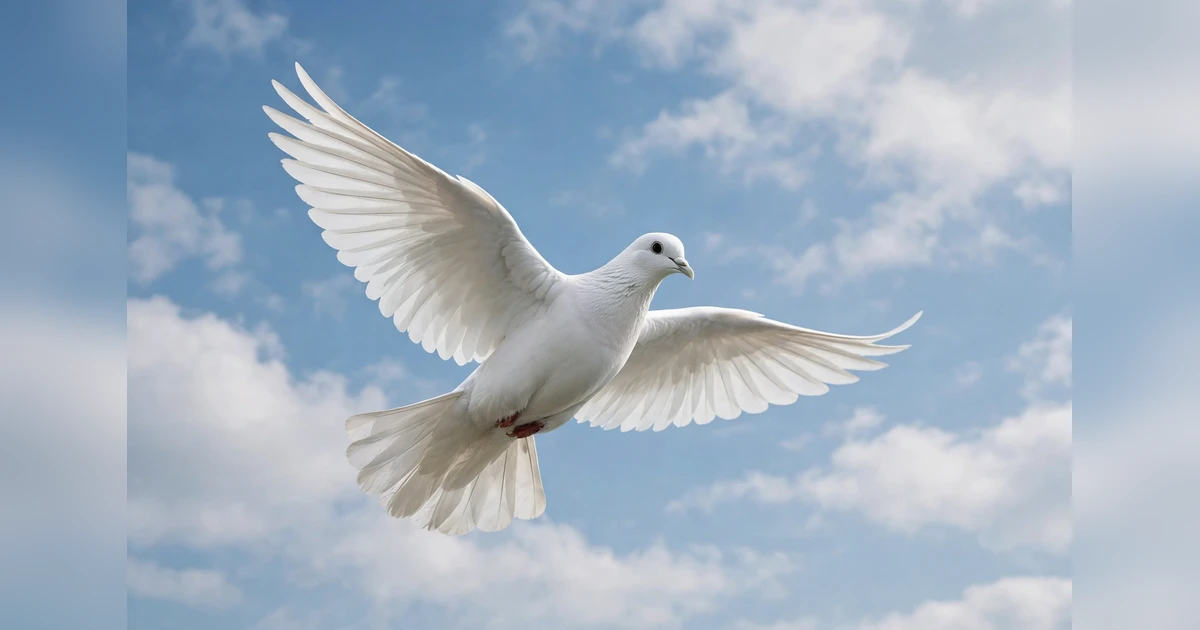
Like a color that changes with light, a white bird changes with the sky, bright white against blue and soft silver against grey. In bright sunlight, a white bird shines. In fog or rain, it softens. That change is part of its beauty, and part of its meaning: a white bird is never the same twice, and it always reflects the sky it flies in.
The White Dove: Peace, the Holy Spirit, and Noah’s Ark
The most famous white bird in the world is the white dove, and its meaning is peace. The white dove as a peace symbol appears across religions and secular contexts, from Noah’s dove returning with an olive branch to Picasso’s lithographs for the World Peace Congress.
In the Bible, the dove is the bird that Noah sent out from the Ark. It returned with an olive branch in its beak, a sign that the flood was ending and that God had made peace with humanity. That story, in Genesis, is the origin of the dove as a symbol of peace, and it is why a dove with an olive branch is still the universal sign of reconciliation.
In Christianity, the Holy Spirit is often depicted as a dove descending from heaven, reinforcing the idea of divine presence and purity. At the baptism of Jesus, the Holy Spirit descended like a dove, and in Pentecost narratives, the dove appears again as a sign of God’s presence. The white dove is therefore not just a symbol of peace. It is a symbol of God himself, coming down to earth in the form of a bird.
Doves are also associated with Aphrodite, the Greek goddess of love. In Greek mythology, white birds, particularly doves, were associated with Aphrodite, while swans were sacred to Apollo and later connected to Zeus. The dove is therefore a bird of love as well as peace: a symbol of devotion, of loyalty, and of a love that is pure and true.
In modern life, white doves are released at weddings to symbolize unity, and at funerals and memorials to represent the soul. A dove released at a wedding says: this love is pure, and it will last. A dove released at a funeral says: this soul is free, and it is at peace. The same bird carries both meanings, because peace and love are the same promise: that what is broken can be made whole.
The White Swan: Grace, Transformation, and the Soul’s Journey
The swan is the most elegant of white birds, and its meaning is grace and transformation. Swans suggest grace and transformation, and they are a symbol of a beauty that is earned, not given.
In Hinduism and Buddhism, the swan, called Hamsa, represents discernment, the ability to separate truth from illusion, just as the swan is said to extract milk from water. In Tantric iconography, it embodies the soul’s journey toward enlightenment. The swan is therefore a spiritual teacher: a bird that knows how to separate what is real from what is false, and how to find the truth in a world of confusion.
In Celtic and Slavic mythology, swans are shape-shifters, associated with poets, seers, and lovers bound by fate. In the Irish tale of the Children of Lir, siblings are transformed into swans for 900 years, their white forms embodying endurance, sorrow, and eventual spiritual release. That story is a reminder that transformation is not always easy: the swan’s beauty is the result of suffering, and its grace is the result of endurance.
The swan is also a symbol of love and loyalty. Swans mate for life, and they are known for their devotion to their partners. A white swan is therefore a symbol of a love that does not fade, and of a partnership that endures through time. When you see a white swan, you are seeing a creature that has chosen its mate and stayed, and that choice is a lesson in loyalty.
The Egret, Heron, and Stork: Patience, Stillness, and New Life
Egrets symbolize patience and stillness. An egret stands motionless in shallow water, waiting for a fish to come close, and then strikes with perfect precision. That stillness is a spiritual lesson: that patience is a form of strength, and that waiting is not the same as doing nothing.
The white heron appears in Japanese Shinto and folklore as a guide for souls crossing into the afterlife. Its silent flight and stillness evoke ma, the aesthetic principle of intentional emptiness and reverence for pause. In Japan, the white heron is a sacred bird, and its presence is a sign that the gods are near.
The white stork is a symbol of new life, of birth, and of good fortune. In European folklore, the stork brings babies to new parents, and its white plumage is a symbol of purity and innocence. A stork nesting on a roof is a sign of good luck, and a stork flying overhead is a sign that something new is coming.
The white crane, in Eastern philosophies such as Buddhism and Hinduism, symbolizes longevity, wisdom, and transcendence. Cranes are known for their long lives, and in Japan, the crane is a symbol of a thousand years of good fortune. A white crane is therefore a wish for a long life, and for a life that is lived with wisdom.
The White Ibis, Owl, and Eagle: Wisdom, Mystery, and Sacred Power
In ancient Egypt, the white ibis represented Thoth, the god of wisdom and writing. The white plumage of the ibis symbolized purity of thought and the divine nature of knowledge. Thoth was the god who invented writing, and the ibis was his bird, because its white feathers were a symbol of a mind that is clear and pure.
The white owl is a more complicated symbol. In some traditions, white owls are seen as harbingers of death or change, especially when appearing near homes or during times of mourning. The owl is a bird of the night, and its white plumage makes it seem like a ghost. But in other traditions, the owl is a symbol of wisdom, of seeing in the dark, and of knowing what others cannot see. The white owl’s meaning depends on the culture, and on the moment: it can be a warning, or it can be a guide.
Among Lakota peoples, the white eagle feather is sacred, not for purity alone, but for its rarity and the eagle’s role as a sky messenger. The eagle is the bird that flies highest, and its white feather is a symbol of a connection to the divine. A white eagle feather is not just a feather. It is a sacred object, and it carries the power of the sky.
White Birds in Christianity, Islam, and Other Faiths
In Christianity, the white dove is the Holy Spirit, and it is the most important bird in the faith. But white birds appear in other faiths as well, and their meanings are just as rich.
In Pagan and Celtic traditions, white birds are believed to carry souls to the afterlife or act as intermediaries between the living and the spirit world. A white bird seen near a grave, or at a funeral, is often interpreted as the soul of the departed, ascending to heaven. That belief is ancient, and it is still held today: that a white bird is a soul in flight.
In Eastern philosophies, white birds like cranes and egrets symbolize longevity, wisdom, and transcendence. In Buddhism, the white bird is a symbol of enlightenment, of a mind that has been purified and is ready to fly. In Hinduism, the swan is the vehicle of the goddess Saraswati, the goddess of knowledge and the arts.
In Islam, birds are seen as signs of God’s creation, and white birds, with their purity, are a reminder of God’s mercy. The dove is a symbol of peace in Islam as well, and it appears in stories of the Prophet Muhammad, where a dove and a spider are said to have protected him in a cave.
Seeing a White Bird: What Does It Mean?
Some common meanings attributed to a white bird sighting include peace and reconciliation, especially with doves, a sighting may remind someone of forgiveness, healing after conflict, or emotional calm. Spiritual awakening is another: many believe white birds signal heightened intuition or a message from a higher power or departed loved one.
Context matters greatly. A white bird appearing at a funeral might be seen as a soul ascending, while one landing near a home could be interpreted as a blessing. However, skeptics argue these perceptions stem from psychological projection rather than supernatural signs. Both views are worth holding: a white bird can be a sign, and it can also be a beautiful bird, and both are true at the same time.
Seeing a white bird spiritually often symbolizes peace, divine guidance, or connection with a loved one who has passed. Interpretations vary by faith and personal belief, but many view it as a positive omen. In many cultures, seeing a white bird, especially unexpectedly, is interpreted as a sign of good fortune or divine presence.
Not every sighting is a sign. Believing every sighting is a sign is a common misconception. Symbolism is personal, not universal. Cultural meaning should be respected. Not every encounter has hidden meaning. Interpretation should remain thoughtful. A white bird can be a message, but it can also be a bird, and the difference is in how you feel when you see it.
White Birds in Dreams
Dreaming of a white bird often evokes feelings of hope, freedom, or spiritual awakening. In Jungian psychology, birds generally symbolize the soul or unconscious mind striving toward higher awareness. White birds specifically symbolize the pure soul, the part of you that is innocent, hopeful, and free.
A flying white bird in a dream means freedom or personal growth. It is a sign that you are rising, that you are letting go of what holds you down, and that you are ready to fly. A resting white bird means peace or emotional balance: a moment of stillness, a time to rest, and a reminder that peace is available to you.
A white bird leaving in a dream means letting go of the past. It is a sign that you are ready to release something, whether it is a relationship, a job, or a part of yourself that no longer serves you. A white bird approaching means new opportunities: something is coming towards you, and it is good.
In dream interpretation, a white bird flying overhead may represent guardian energy watching over you. That is a comforting dream, and it is one that many people have after losing a loved one. The white bird is a reminder that you are not alone, and that someone is watching over you.
White Birds in Love, Tattoos, and Modern Culture
White birds often appear in romantic symbolism. Their meaning usually centers on purity and connection. True love and loyalty, emotional harmony, new beginnings in relationships, trust and honesty: these are the meanings that white birds carry in love. White doves are released at weddings, and white swans are a symbol of a love that lasts for life.
White bird tattoos are popular, and they often carry personal meaning. They represent a fresh start, they honour a lost loved one, they symbolize inner peace, and they reflect personal growth. Popular styles include minimalist white bird outlines, flying birds across the shoulder, single dove designs, and abstract or watercolour styles. A white bird tattoo is a way of carrying a symbol with you, always.
In modern media, white birds appear in films to signal peace or resolution, in logos for calm or purity, in inspirational content, and in nature photography. They are a symbol that everyone understands, even without words: a white bird means peace, and it means hope.
Misunderstandings: When a White Bird Is Not a Good Omen
Not all interpretations of white birds are positive. Some meanings can be misunderstood or exaggerated, and it is important to know the other side.
In some traditions, a white bird, especially a white owl, is seen as a harbinger of death. That belief is ancient, and it is still held in some parts of the world. A white bird appearing near a home during a time of illness or mourning can be a frightening sign, and it is important to respect that fear, even if you do not share it.
Another misconception is assuming one fixed meaning for all cultures. White birds mean different things in different places. In Asia, white birds can represent the afterlife. In Europe, they often symbolize the soul. In Indigenous traditions, they act as guides. In folklore, they can be omens or protectors. No single meaning fits all cultures, and that is as it should be.
Over-spiritualizing ordinary events is another trap. Not every white bird is a message from heaven. Sometimes, a white bird is just a bird, and that is enough. The beauty of a white bird does not need a hidden meaning to be meaningful. Sometimes, the message is simply: look up, and see something beautiful.
Frequently Asked Questions
What does seeing a white bird mean?
It often symbolizes peace, hope, or guidance. However, meaning depends on personal belief and context. A white bird at a funeral may mean a soul ascending, while one near a home may mean a blessing.
Are white birds a sign from heaven?
Some people believe they are messages from loved ones or spiritual forces. Others see them as natural events. Both views are valid, and the meaning is often personal.
What does a white bird symbolize in the Bible?
It usually represents the Holy Spirit, purity, and divine presence. The dove in Noah’s Ark is a symbol of peace after the flood, and the dove at Jesus’ baptism is a symbol of the Holy Spirit.
Is a white bird good luck?
In many cultures, yes. It is often seen as a positive and hopeful sign, a symbol of peace, freedom, and new beginnings.
What does a white bird mean in dreams?
It often reflects peace, growth, or emotional clarity. A flying white bird means freedom, a resting bird means peace, a bird leaving means letting go, and a bird approaching means new opportunities.
Which white birds are the most symbolic?
The dove means peace and love, the swan means grace and transformation, the egret means patience and stillness, the white pigeon means messages and connection, and the white crane means longevity and wisdom.
Can a white bird be a bad omen?
In some traditions, yes. A white owl, in particular, can be seen as a harbinger of death or change. The meaning depends on the culture and the context, and it is important to respect local beliefs.
Final Thoughts
White birds carry a quiet but powerful message. Across history, they have symbolized peace, purity, and connection between worlds. In the United States, they have become deeply tied to freedom, hope, and emotional healing. At the same time, their meaning is not fixed. It changes with culture, belief, and personal experience. That is why white bird symbolism continues to evolve and stay relevant.
In the end, a white bird means what it feels like to you. Whether it is a sign, a reminder, or simply a beautiful moment, it invites you to pause and reflect. Look up when a white bird flies overhead. Notice its whiteness against the sky, its quiet flight, and its gentle presence. And ask yourself: what is it telling me?
The answer may be peace. It may be hope. It may be that someone you love is watching over you. Or it may simply be that the world is beautiful, and that you are lucky enough to see it. Any of those answers is enough.